
Blog
How Texas Community Property Rules Divide Business Equipment in a Harris County Divorce
Texas community property law doesn't split a contractor's excavators or a trucking fleet down the middle automatically: it first asks what's separate, what's marital, and what the equipment is worth as of the right date. This guide walks Harris County business owners through the inception-of-title doctrine, reimbursement claims, and why a defensible equipment appraisal often decides the outcome.
When one spouse owns a construction company, an oilfield services outfit, a manufacturing shop, or a trucking fleet, a Houston divorce usually turns into an equipment case almost as much as a marriage case. Cranes, excavators, CNC machines, tractors, and semi trucks are often the single largest asset class in the marriage, and Texas law does not simply cut them in half. Courts first decide what is community property, what is separate property, and what each piece of equipment is actually worth before they divide anything.
This matters because Harris County family courts handle a steady docket of business-owner divorces tied to the region's construction, oilfield services, manufacturing, and fleet operations. Getting the characterization and the valuation date wrong can cost a spouse real money, whether they are trying to keep the business running or trying to collect their fair share of it. A divorce equipment appraisal built around the correct legal framework is often what keeps a settlement or a trial outcome defensible.
Is Business Equipment Community Property in a Texas Divorce?
In most cases, yes. Texas is a community property state, and property either spouse possesses during the marriage is presumed to belong to the community estate. The spouse claiming that a piece of equipment, or an entire business, is separate property carries the burden of tracing it to separate funds or a pre-marriage acquisition by clear and convincing evidence.
That presumption is strong, and it applies equipment-by-equipment, not just business-by-business. A bulldozer bought with marital funds two years into the marriage is community property even if it sits on the books of a company the husband founded before the wedding. The analysis typically looks at:
- When the equipment was acquired, relative to the date of marriage.
- Whether it was purchased with community earnings, joint debt, or traceable separate funds.
- Whether separate and community money were commingled in the purchase or financing.
- Whether the asset belongs to a corporation, LLC, or sole proprietorship, which can shift the analysis from the machine itself to the ownership interest in the business.
- Whether the equipment was traded in, refinanced, or materially upgraded during the marriage.
The Inception-of-Title Doctrine: When Equipment Stays Separate
Texas follows the inception-of-title doctrine, which means a piece of equipment's character as separate or community property is fixed at the moment the right to acquire it arose, not when it was paid off, titled, or improved. If a spouse signed a purchase contract or financing agreement for a crane before the marriage, that crane generally stays separate property even if loan payments continued for years after the wedding, as long as the funds used to pay it off can be traced.
The same logic applies to a business itself. A construction company founded before marriage is typically separate property, even though its fleet grows, its contracts expand, and its revenue increases during the marriage. What changes is not ownership; what can change is whether the community estate has a claim against the growth.
Mixed-Character Equipment and Reimbursement Claims
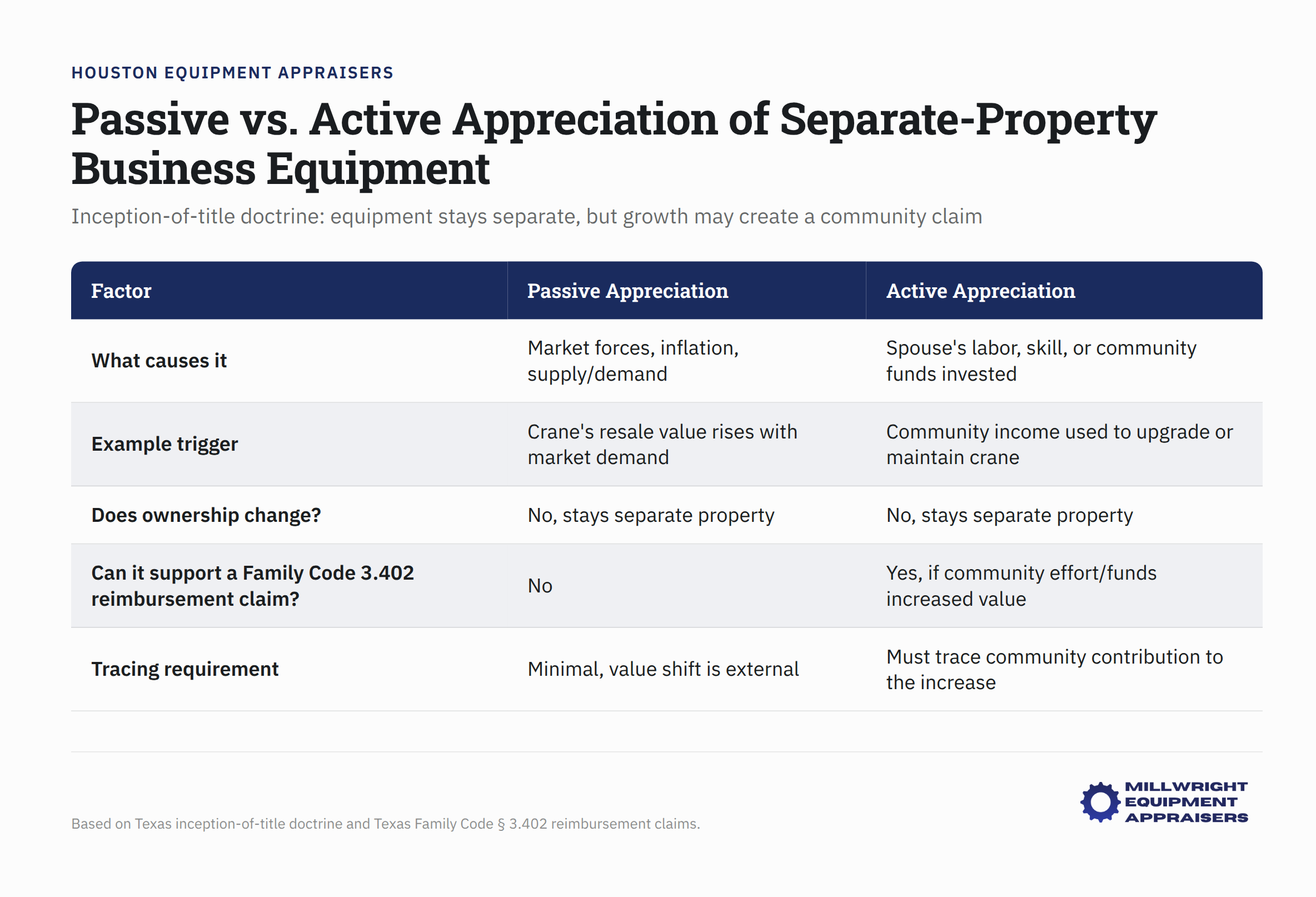
Separate-property equipment does not automatically convert to community property just because marital money or marital labor kept it running. But the community estate can have a reimbursement claim under Texas Family Code section 3.402 when community funds or community labor are used to maintain, upgrade, or expand a spouse's separate-property equipment or business. That claim is measured by the enhancement in value the community contribution produced, not simply by the dollars spent.
This is where the distinction between passive and active appreciation becomes central to the case:
- Passive appreciation happens when equipment or a business gains value because of market conditions, inflation, or general industry demand, with no meaningful community effort behind it. A crane that appreciates because used-equipment prices rose industry-wide stays separate property in value as well as title.
- Active appreciation happens when community labor, community funds, or the owner spouse's time and effort during the marriage caused the increase, such as reinvesting business profits into new machinery, financing a fleet expansion with marital credit, or the owner spouse drawing a below-market salary while plowing earnings back into equipment. Active appreciation can support a reimbursement claim even though the underlying business or original equipment remains separate property.
Example: A spouse owned a small excavation company with two machines before the marriage. During the marriage, the company used retained earnings and the owner's labor to add four more excavators and a fleet of dump trucks. The original two machines and the company itself likely remain separate property, but the community estate may have a reimbursement claim tied to the value the community's labor and reinvested earnings added to the fleet.
Why the Valuation Date Can Make or Break the Division
Texas courts, including Harris County family courts, generally value community property assets, including business equipment, as of the date of trial on the merits rather than the date of filing or separation, although a court retains some equitable discretion to use a different date when the circumstances call for it, as explained by the Texas State Law Library's guidance on property division in divorce.
That timing rule carries real consequences for heavy equipment. A crane, a fleet of semi trucks, or a bank of CNC machines can lose or gain significant value in the months (or years) between when a petition is filed and when the case actually goes to trial. Diesel equipment depreciates on a fairly predictable curve, but demand spikes, supply shortages, or a hot used-equipment market can push values the other direction just as fast. A valuation performed at filing and never updated can leave one spouse arguing over a number that no longer reflects reality by the time the judge rules.
Watch out: If a case drags on, the original appraisal may need to be refreshed or re-issued as a retrospective valuation tied to the correct effective date, not simply relied upon as-is months or years later.
How Harris County Courts Typically Divide Business Machinery
Texas Family Code section 7.001 requires the court to divide the community estate in a manner that is "just and right," with due regard for each spouse's rights, and the court may not award one spouse the other spouse's proven separate property. A 50/50 split is not required, and courts have discretion to divide the estate unevenly when circumstances support it, but the division must be grounded in the community estate as a whole and in the evidence presented, as reflected in general Texas divorce property guidance from TexasLawHelp.
In practice, Harris County cases involving a machinery-heavy business tend to resolve along a few recurring paths.
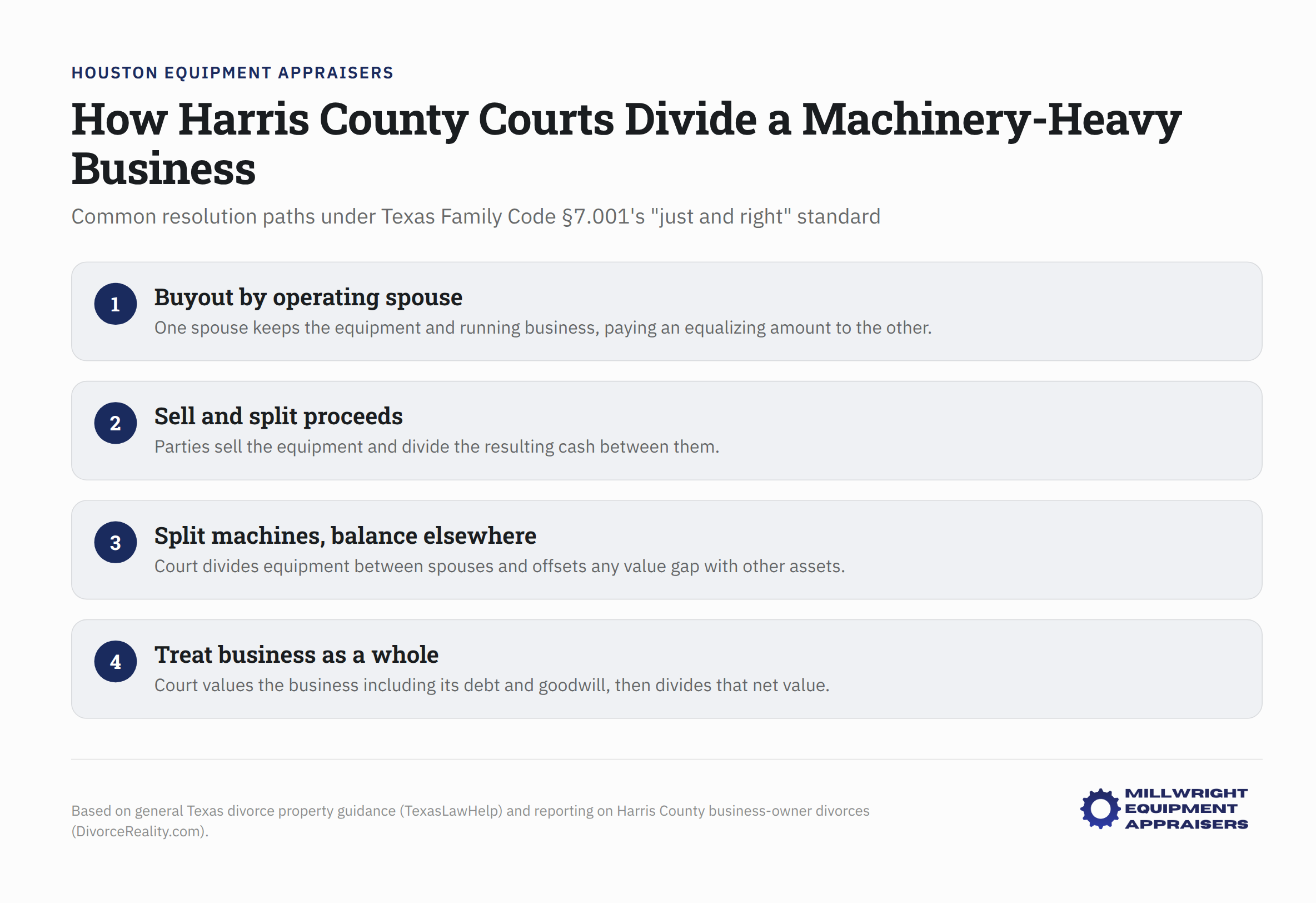
Local family law practitioners who handle Harris County business-owner divorces describe similar patterns playing out across construction, oilfield services, and fleet-based businesses, where the operating spouse typically wants to keep the equipment running rather than see it liquidated, as discussed in coverage of business owner divorces in Harris County.
What a Defensible Equipment Appraisal Needs to Show
Tax depreciation schedules are not evidence of market value, and courts know it. A Schedule C or a company's fixed-asset ledger will show original cost less accounting depreciation, which almost never matches what a crane, a tractor, or a fleet of trucks would actually sell for on the open market. An appraisal built for a divorce needs to stand on its own, separate from the company's books.
A report that holds up in a Harris County courtroom or supports a settlement negotiation should generally include:
- A stated valuation premise, typically fair market value, consistent with the Uniform Standards of Professional Appraisal Practice (USPAP) published by The Appraisal Foundation.
- The correct effective date, tied to the date of trial on the merits or another date the court has identified, with a retrospective valuation prepared if the case has been delayed.
- Methodology recognized by Texas courts, generally the cost approach, income approach, or market-data comparison approach, with the market approach typically carrying the most weight for individual pieces of heavy equipment. The Texas Supreme Court has described these three approaches in detail in the context of property appraisal, citing provisions of the Texas Tax Code, as outlined in its opinion on equipment and inventory valuation methodology.
- Clear treatment of debt and liens, since a machine's net equity (its fair market value minus any loan payoff or lien) is what actually matters to the division, not gross value.
- Documentation that separates passive appreciation from active appreciation where a reimbursement claim is in play, since the two require different evidence and different conclusions.
Our team prepares USPAP-compliant equipment appraisals for Houston-area construction firms, oilfield service companies, manufacturers, and trucking operations facing exactly these questions, and we can read our FAQ on how fair market value is determined for equipment for more detail on the methodology courts expect to see. Fees for a divorce equipment appraisal are quoted as a fixed amount after we scope the assignment (the number of units, the complexity of the fleet, and whether a retrospective valuation is required), never billed by the hour.
Protecting Your Position Before the Case Goes to Trial
Business-owner divorces involving heavy equipment rarely settle well when the valuation work starts late. Pin down the character of each major asset early, understand whether reimbursement issues are realistically on the table, and get an appraisal tied to the date your case will actually be decided on, not the date you filed. A credentialed, independent valuation gives both spouses, and the court, a number they can trust.
This article is provided for general informational purposes only and does not constitute legal, tax, or financial advice. Readers should consult a qualified Texas family law attorney regarding their specific circumstances.