
Blog
Stepped-Up Basis for Inherited Equipment in a Harris County Texas Estate
Stepped-up basis resets inherited equipment's tax basis to its fair market value on the date of death, wiping out the decedent's old depreciation schedule. This guide walks Harris County heirs, executors, and their advisors through the IRC Section 1014 rule, the 90-day probate inventory deadline, and what a later equipment sale will actually cost in tax.
When a Harris County family inherits a tractor, an excavator, or a fleet of restaurant equipment, the tax question that follows isn't always obvious. The decedent may have owned that equipment for 15 years and depreciated it down to almost nothing on their books. None of that carries over to the heir. Under federal tax law, the heir's starting basis resets to the equipment's fair market value on the date of death, a concept called stepped-up basis, and getting that number right with a defensible appraisal matters the moment the equipment is sold, financed, or reported to a probate court.
This matters for three groups at once: the heir who eventually sells or keeps using the equipment, the executor who has to file an inventory with the probate court, and the CPA or attorney advising both. Our probate equipment appraisal guide for Texas estates covers the filing side in depth. This article focuses specifically on what stepped-up basis means for equipment, how it differs from the decedent's depreciation history, and what happens at the eventual sale.
What Does Stepped-Up Basis Mean for Inherited Equipment?
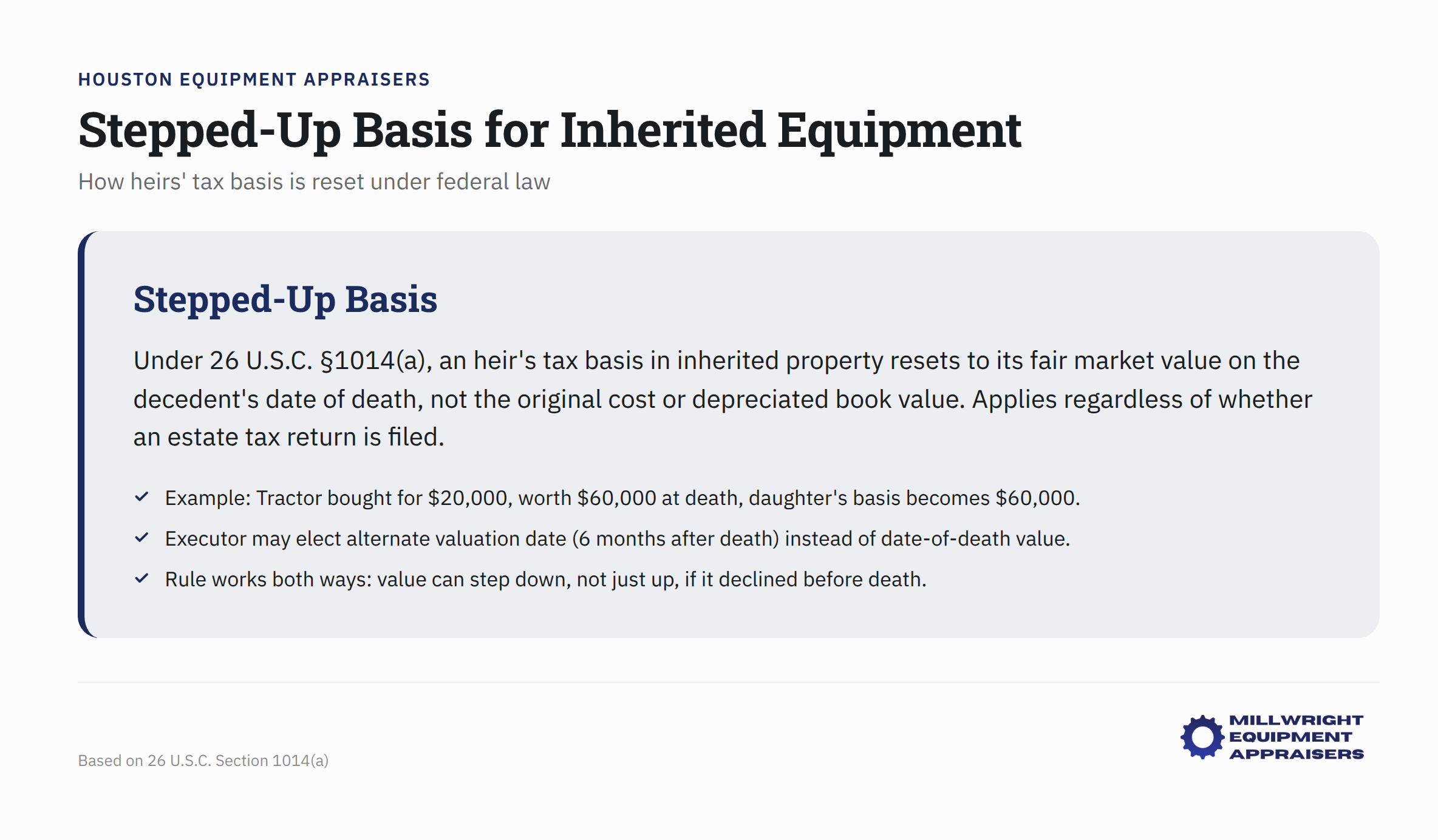
Stepped-up basis means the heir's tax basis in inherited property is reset to its fair market value on the decedent's date of death, not the decedent's original cost or remaining book value. This comes from 26 U.S.C. Section 1014(a), which governs the basis of property acquired from a decedent, and it applies whether or not the estate ever files a federal estate tax return.
Example: A Harris County rancher bought a tractor years ago for $20,000 and had depreciated it to almost nothing by the time he passed away. An appraisal establishes its fair market value at $60,000 on the date of death. His daughter, who inherits the tractor, does not inherit his $20,000 basis. Her new basis is $60,000, the appraised date-of-death value, regardless of what her father originally paid or how much he'd already written off.
If the estate's executor elects the alternate valuation date allowed under federal law (six months after death, used only when properly elected on the estate's federal filing), that later value replaces the date-of-death figure instead. Outside of that election, the date-of-death appraisal is what controls.
Watch out: If the equipment's value actually declined between purchase and death (unusual for most machinery, but possible for obsolete or damaged equipment), the basis can step down instead of up. The rule works in both directions.
Why the Heir's Basis Isn't the Decedent's Depreciation Schedule
The heir does not inherit the decedent's depreciation schedule, recovery period, or remaining useful life for tax purposes. The stepped-up fair market value becomes a brand-new depreciable basis if the equipment goes into business use after inheritance, and the heir starts a fresh depreciation schedule from that number under the recovery period that applies to the asset class.
This is a common point of confusion for families managing a parent's business or farm. The decedent may have been three years from fully depreciating a piece of equipment. The heir doesn't pick up where that schedule left off. If the tractor in the earlier example carried a $60,000 stepped-up basis and the daughter puts it into her own farming operation, she begins depreciating from $60,000, following the applicable recovery period for that equipment class, as if she had just purchased it for that amount.
Key takeaway: The date-of-death appraisal does two jobs at once. It sets the heir's new basis for a future sale, and it sets the heir's new depreciable basis if the equipment goes back into business use.
Harris County's 90-Day Inventory and Appraisement Deadline
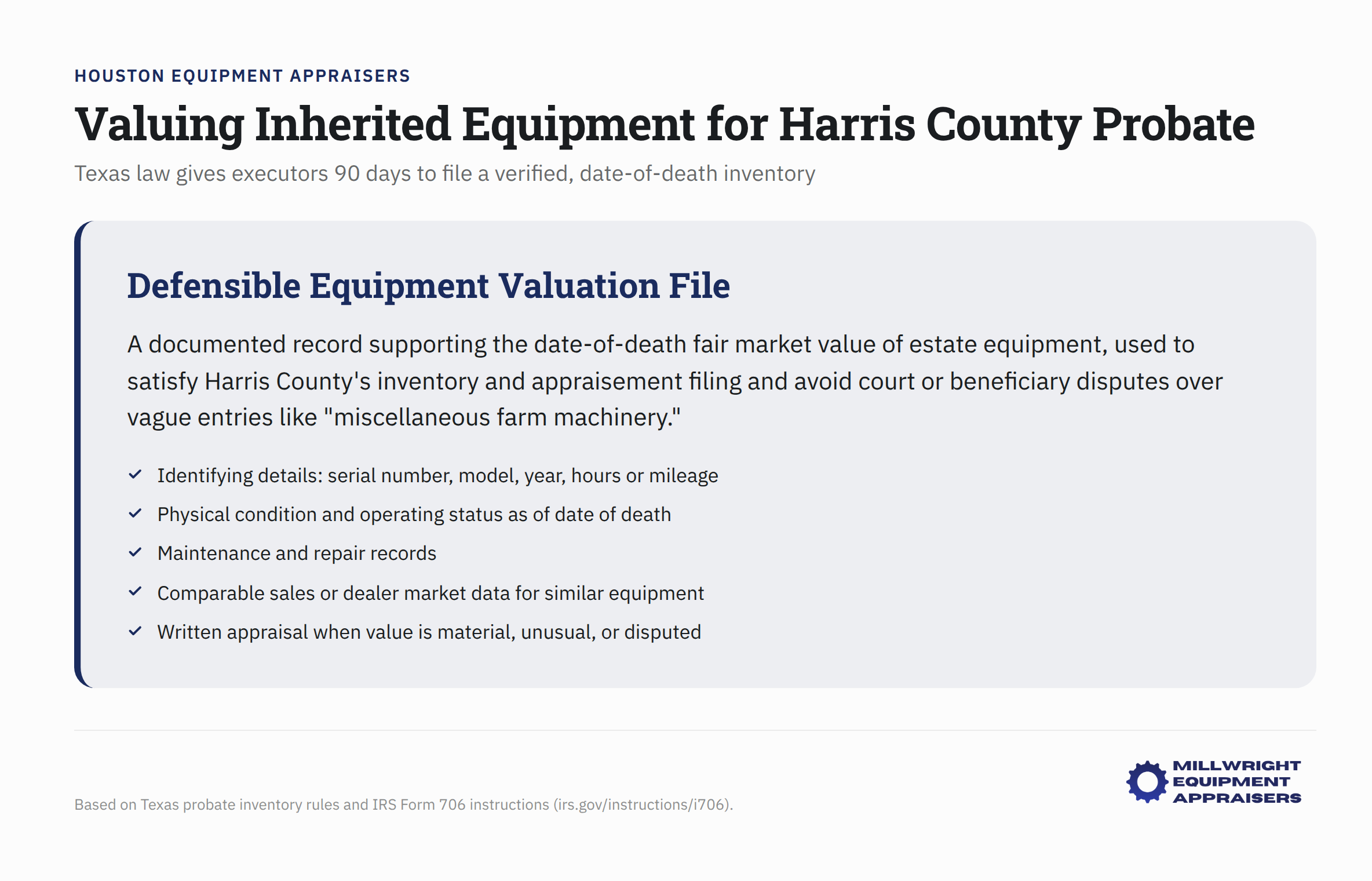
Texas probate law requires an independent executor to file a verified inventory, appraisement, and list of claims generally within 90 days of qualifying, listing the date-of-death fair market value of every estate asset, including equipment. Harris County probate courts review that filing and can require a corrected version if the valuations or descriptions are inadequate.
In some circumstances, Texas law allows an executor to file an affidavit in lieu of the court inventory when there are no unpaid debts beyond certain exceptions, though a detailed inventory must still be provided to the beneficiaries even then. Either way, someone has to put a real number on the equipment.
This is where generic language causes problems. An inventory line that reads "miscellaneous farm machinery, $40,000" invites exactly the kind of court scrutiny or beneficiary dispute that a specific, documented, date-of-death appraisal avoids. Equipment is harder to value from memory or a used-equipment listing than most household goods: condition, hours of operation, maintenance history, and local dealer or auction data all affect the number, and the IRS's own Form 706 instructions lay out the kind of evidence an estate valuation should be built on, even when the estate itself isn't large enough to owe federal estate tax.
A defensible equipment valuation file for probate purposes typically includes:
- Identifying details: serial number, model, year, and hours or mileage
- Physical condition and operating status as of the date of death
- Maintenance and repair records
- Comparable sales or dealer market data for similar equipment
- A written appraisal when the value is material, unusual, or likely to be disputed by the court or beneficiaries
Selling the Equipment Later: Gain, Loss, and Depreciation Recapture
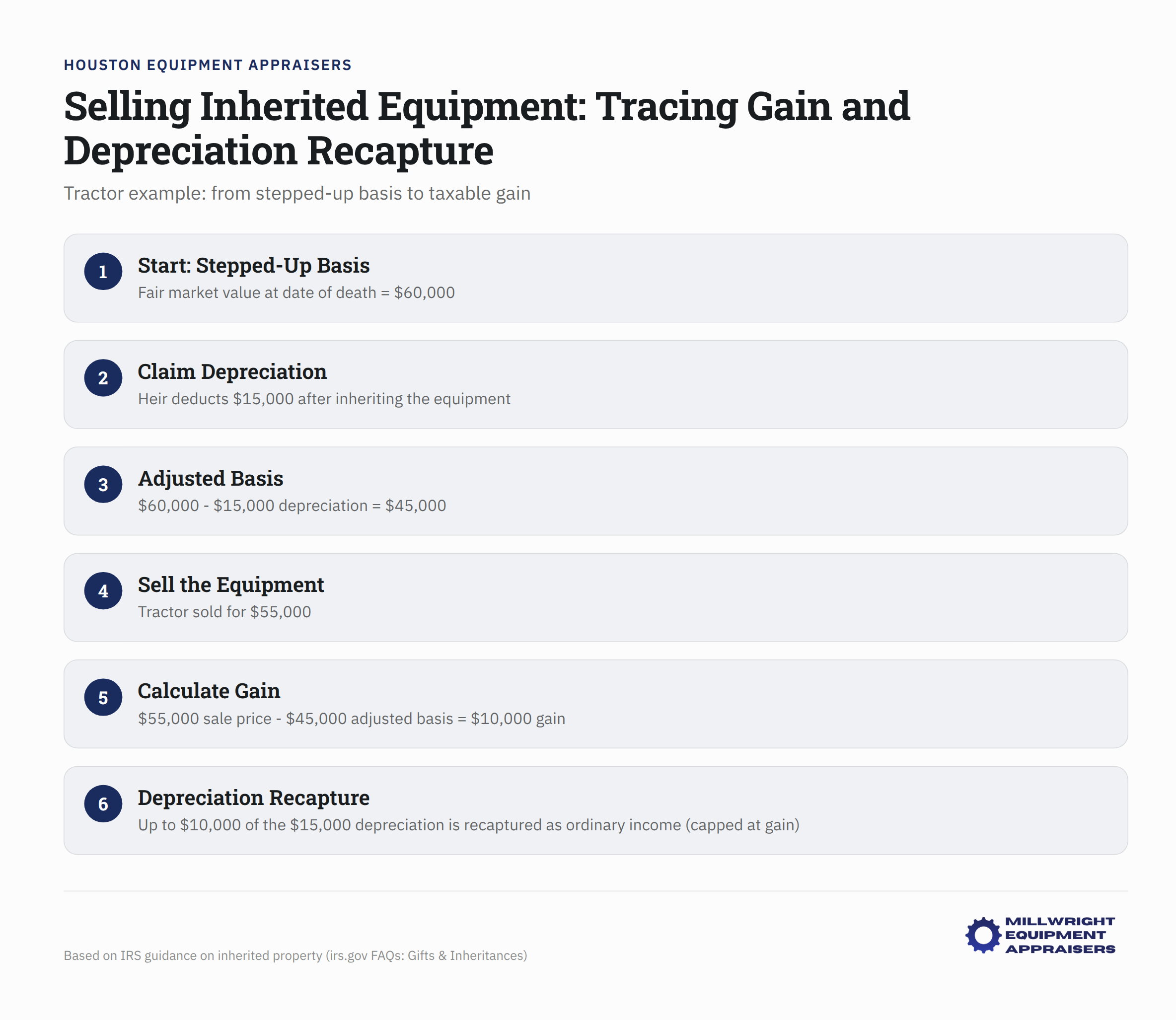
When the heir eventually sells inherited equipment, gain or loss is calculated as the amount received minus the heir's adjusted basis, not the decedent's original cost. The adjusted basis starts at the stepped-up fair market value and is reduced by any depreciation the heir claims after inheriting it.
Example: Continuing the tractor example, the daughter's stepped-up basis is $60,000. She uses it in her operation for a few years and claims $15,000 in depreciation deductions. Her adjusted basis is now $45,000. She then sells the tractor for $55,000. Her gain is $10,000 ($55,000 minus $45,000).
Business equipment like this is generally treated as Section 1245 property, which means depreciation the heir claims after inheriting it (not the decedent's prior depreciation) can be recaptured as ordinary income on sale, limited to the gain actually recognized. In the example above, the $15,000 of depreciation the daughter claimed would be recaptured as ordinary income, but only up to the $10,000 gain she recognized, since recapture can't exceed the gain itself.
The practical lesson: the decedent's old depreciation never follows the equipment to the heir, but the heir's own post-inheritance depreciation absolutely does follow them to the sale. The IRS's guidance on inherited property confirms that a sale soon after death, close to the established fair market value, often produces little gain or loss precisely because the stepped-up basis and the sale price land close together.
Pro tip: If equipment is sold within a year or two of the date-of-death appraisal, keep that appraisal report with the sale records. It's the single piece of documentation that supports both the basis used on the return and the reasonableness of the sale price.
Where Texas Law Fits In
Texas has no separate state inheritance tax or state estate tax, so for most Harris County families, stepped-up basis for inherited equipment is entirely a federal question governed by IRC Section 1014 and the corresponding Treasury Regulation 1.1014-1, confirmed by general industry knowledge of Texas's lack of a state inheritance tax. Harris County's role is administrative: probate venue, inventory review, and ownership records. It doesn't create a different basis formula.
That doesn't make the local filing a formality. The number an executor puts on an equipment inventory can become the number an heir relies on years later when a CPA prepares a sale, a lender asks for collateral documentation, or the IRS asks how a basis was determined. A professional, date-of-death appraisal, prepared in accordance with USPAP, gives everyone in that chain a defensible figure instead of a guess.
For estates working through this process, we prepare date-of-death and probate inventory appraisals for farm, construction, and business equipment across Harris County, structured to meet both the court's inventory requirements and the documentation a later sale or depreciation schedule will need. Our team can also answer the baseline question of what an equipment appraisal actually involves before an executor commits to one.
If you're managing an estate that includes equipment and need a date-of-death valuation for probate, basis, or depreciation purposes, request an equipment appraisal and we'll scope the engagement to the court's deadline.
This article is provided for general informational purposes only and does not constitute legal, tax, or financial advice. Readers should consult a qualified attorney or CPA regarding their specific circumstances.