
Blog
Harris County Business Personal Property Tax Rules Every Houston Equipment Owner Should Know
Harris County business personal property tax renditions require Houston equipment owners to report machinery and equipment to HCAD every April 15, and getting the value wrong costs money either way. Here is what Section 22.01 requires, what the late-filing penalty looks like, and how a documented appraisal supports both the rendition and a protest.
If your business owns machinery, shop equipment, computers, or fixtures anywhere in Harris County, the Harris Central Appraisal District (HCAD) expects you to report it every year, whether or not you ever hear from them first. The business personal property rendition is what turns your equipment into a taxable value on the county's rolls, and getting the filing wrong, or skipping it, carries real financial consequences. This guide walks Houston equipment owners and their CPAs through the filing deadline, what the Texas Tax Code actually requires you to report, the penalty for missing it, and how to challenge a value that does not match what your equipment is actually worth. Our Houston equipment appraisal team prepares the documented valuations that make this process defensible, whether you are filing the rendition itself or pushing back on HCAD's number.
What Counts as Business Personal Property Equipment in Harris County?
Business personal property covers most tangible assets a company uses to produce income, not just the machinery on the shop floor. The Texas Comptroller's business personal property rendition schedule describes these categories as including machinery and production equipment, furniture and fixtures, computers and electronics, inventory and supplies, and business vehicles, vessels, or aircraft, per the Comptroller's Form 50-144 rendition of business personal property. HCAD is the local authority that receives these renditions and appraises the reported property each year, a role described on Harris County's government site.
If equipment is used to generate income and sits in Harris County for more than a temporary period, it is generally taxable and must be rendered unless a narrow value exception applies (covered below). That includes leased equipment in many cases, computers and point-of-sale systems, and specialized machinery tied to manufacturing, medical, restaurant, or industrial operations.
When Is the HCAD Business Personal Property Rendition Due?
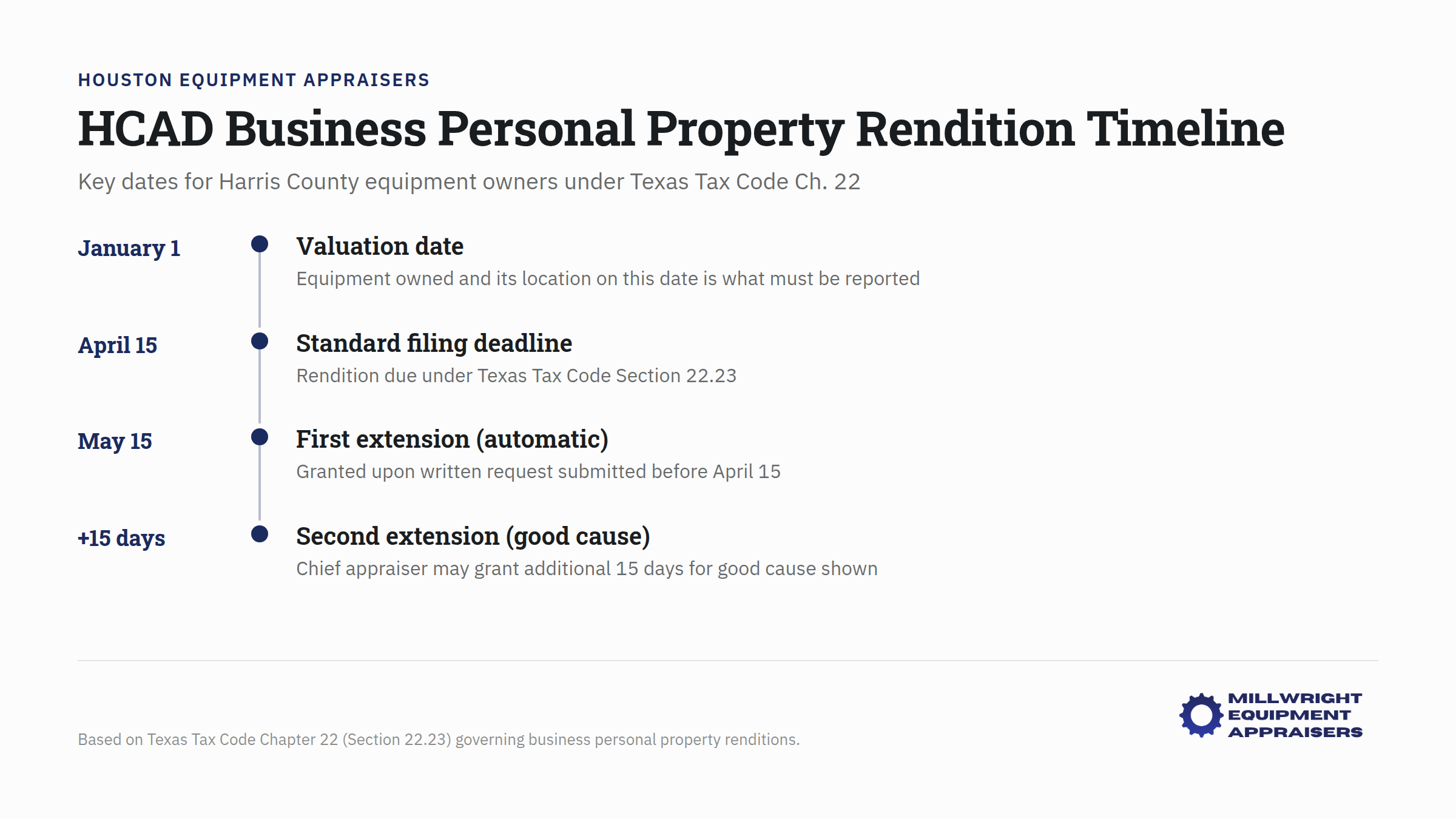
The rendition is due April 15 each year, covering property owned as of January 1, under Texas Tax Code Section 22.23. Owners can request a written extension that pushes the deadline to May 15, and the chief appraiser may grant an additional 15 days for good cause shown, per Texas Tax Code Chapter 22.
That gives a Houston equipment owner three effective checkpoints in a normal year:
- January 1: the valuation date. Whatever equipment you own and where it sits on this date is what gets reported.
- April 15: the standard filing deadline for the rendition.
- May 15, plus up to 15 additional days: the extended deadline if you request it in writing before April 15 and, where needed, show good cause for the second extension.
Pro tip: Request the extension in writing well before April 15, even if you expect to file on time. It costs nothing and gives you a buffer if your equipment list or cost records turn out to be incomplete.
What Section 22.01 Requires You to Report on Equipment
Texas Tax Code Section 22.01 sets out exactly what belongs on the form, and it is more specific than most owners expect. The rendition must include the owner's name and address, a description of the property by category, the property's location (its situs) within the county, and either a good-faith estimate of the property's market value or its historical cost when new along with the year it was acquired.
That last part matters. You are not required to guess at a market value if you do not have one; reporting the original cost and acquisition year is an accepted alternative, and HCAD applies its own depreciation schedules to convert that cost data into an appraised value. Owners who do have a defensible market value estimate, based on a current appraisal rather than a rolled-forward cost figure, can report that instead. Our guide on how fair market value is determined for equipment walks through the approaches appraisers use to reach that number.
Dollar Thresholds That Determine Your Filing Burden
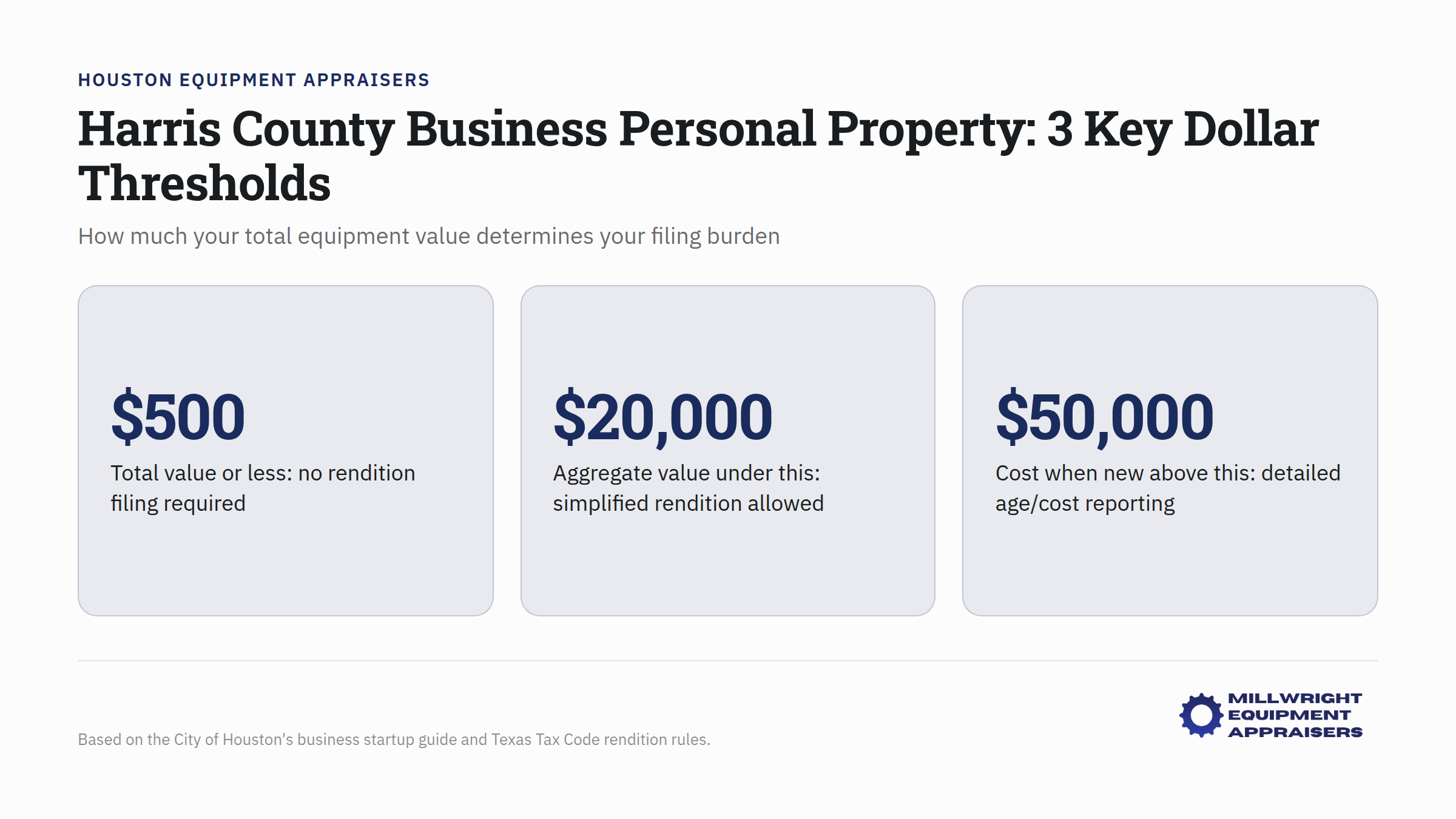
Three separate dollar thresholds change how much reporting a Houston equipment owner actually has to do, and they are easy to confuse:
- Under $500 total value: businesses whose total personal property value is $500 or less are not required to file a rendition at all, a local application of state law described in the City of Houston's business startup guide.
- Under $20,000 aggregate value: owners whose equipment and other taxable personal property has an aggregate value under $20,000 in their own opinion can use a simplified rendition format with less detailed reporting.
- Over $50,000 historical cost when new: individual assets above this cost threshold trigger more detailed reporting requirements around age and acquisition cost under the Tax Code.
Most small and mid-size Houston operations fall somewhere between the first two thresholds: required to file, but eligible for the simplified format. Larger equipment fleets, industrial plants, and specialized machinery accounts are more likely to cross into the detailed reporting tier.
The 10% Penalty for Filing Late
Missing the deadline is not a paperwork inconvenience, it is a statutory penalty. Texas Tax Code Section 22.28 imposes a penalty equal to 10% of the tax ultimately imposed on the property for a rendition that is not timely filed. HCAD reinforces this every filing season with reminders that reporting equipment, office assets, and inventory by April 15 is mandatory, not optional, a point echoed across Harris County's own tangible personal property tax guidance.
Watch out: The penalty applies even if you simply forget to file, not just if you underreport intentionally. And if you never render at all, HCAD does not leave the account blank; it estimates a value for you, often using assumptions that run higher than a properly documented rendition would have produced.
Why You Should Not Just Roll Forward Last Year's Numbers
A common mistake among Houston equipment owners is copying last year's rendition, changing the date, and refiling. Equipment values move year to year, sometimes sharply, as used equipment markets shift, new models change resale demand, and depreciation schedules catch up to older assets. HCAD's own market data reflects these swings across categories, which is exactly why a rendition built on a five-year-old cost figure can drift further from actual market value with each passing filing season.
This is where the historical-cost reporting option becomes a trap for the unwary. It is allowed under Section 22.01, but reporting stale cost data year after year without adjusting for actual depreciation and market conditions tends to either overstate or understate value, neither of which serves the owner well.
Protesting an Over-Assessed Equipment Value
If HCAD's appraised value for your equipment does not match what the equipment is actually worth, Texas Tax Code Sections 41.41 and 41.44 give you the right to protest. The deadline is May 15, or 30 days after HCAD mails the notice of appraised value, whichever is later. Accepted grounds include an incorrect market value determination and unequal appraisal, meaning your equipment was assessed at a higher percentage of its actual value than comparable property in the same category.
A protest built on a bare assertion ("this number seems too high") rarely moves an appraisal review board. A protest built on a documented, methodology-backed valuation, prepared to the standard set by the Uniform Standards of Professional Appraisal Practice (USPAP), gives the board something concrete to weigh against HCAD's cost-and-depreciation schedule.
How a Professional Equipment Appraisal Supports Your Rendition or Protest
An independent equipment appraisal does two jobs at once for Houston business owners: it gives you a defensible market value figure to report on the rendition itself, and it gives you the evidence you need if you later decide to protest HCAD's assessed value. Rather than reporting a historical cost figure that may no longer reflect reality, an appraisal documents current market value using recognized approaches, comparable sales, and depreciation analysis specific to your equipment category.
For most machinery and equipment engagements, a standard appraisal report is quoted as a fixed fee starting around $295, scoped to the number of assets, their complexity, and whether the report needs to meet a heightened standard for a specific filing purpose. The fee is set before work begins based on the scope of the assignment, not on the value of the equipment itself.
If you manage machinery across a manufacturing floor, a restaurant kitchen, or a fleet of construction assets, an appraisal also gives your CPA or fiduciary a single, organized record to work from at tax time instead of scattered purchase invoices and guesswork. Our equipment appraisal request page is the starting point when you are ready to get that documentation in place before the next April 15 deadline arrives.
This article is provided for general informational purposes only and does not constitute legal, tax, or financial advice. Readers should consult a qualified attorney or CPA regarding their specific circumstances.