
Blog
Harris County Business Personal Property Tax Appeal: Rendition Deadlines and the Protest Process for Equipment Owners
Harris County equipment owners face an April 15 rendition deadline and a separate, later deadline to protest an assessed value that runs too high. This guide walks through both filings and shows what evidence actually moves a harris county business personal property tax appeal forward at the Appraisal Review Board.
If you own machinery, furniture, or equipment used in a Harris County business, you owe the appraisal district two separate filings each year, and they run on two separate clocks. The first is the rendition, due every April 15, where you report what you own. The second is the protest, filed later in the spring, where you push back if the district's valuation of that equipment is too high. Missing either deadline costs money: a late rendition triggers a penalty, and a missed protest window can mean living with an inflated value for the entire tax year.
This guide walks through both processes in order: what the rendition requires, when it's due, how the Harris Central Appraisal District (HCAD) arrives at an equipment value, and the step-by-step path for a harris county business personal property tax appeal when that value doesn't match reality. For a broader look at how Harris County treats business personal property generally, see our overview of Harris County business personal property tax rules.
Who Has to File a Harris County BPP Rendition?
Any business that owned taxable personal property in Harris County on January 1 of the tax year generally has to file a rendition. Texas Tax Code Chapter 22 requires the owner of tangible personal property used to produce income to deliver a rendition statement to the chief appraiser describing that property.
For an equipment-owning business, that typically means:
- Machinery and production equipment used in manufacturing, fabrication, or service work
- Computers, office equipment, and furniture and fixtures
- Vehicles and other movable assets taxed as personal property rather than through vehicle registration
- Inventory, supplies, and other business personal property on hand
- Any equipment acquired, sold, transferred, or removed from the location during the prior year
January 1 is the key date. Even if you sold a piece of equipment on January 2, you still owned it on the assessment date and generally still have to report it.
What Goes on the Rendition Form
The rendition is filed on the Texas Comptroller's general personal property rendition form, and it asks for more than a list of equipment. For each category of property, you provide a description of the asset, the year it was acquired, and either a good-faith estimate of its market value or its historical cost along with its age, so the district can apply a depreciation schedule.
A business that skips this step, or reports it loosely, hands HCAD the job of estimating value on its own. HCAD's mass appraisal models apply standard percent-good depreciation tables to broad equipment categories. Those tables are built for averages across thousands of accounts, not for the specific condition, utilization, or obsolescence of your equipment. That's one of the most common reasons an equipment owner ends up with an assessed value that's higher than what the equipment would actually sell for.
Pro tip: Keep a running fixed-asset list throughout the year, not just in March. Recording disposals, additions, and transfers as they happen makes the April rendition a 20-minute update instead of a scramble.
Rendition Deadlines and the Penalty for Filing Late
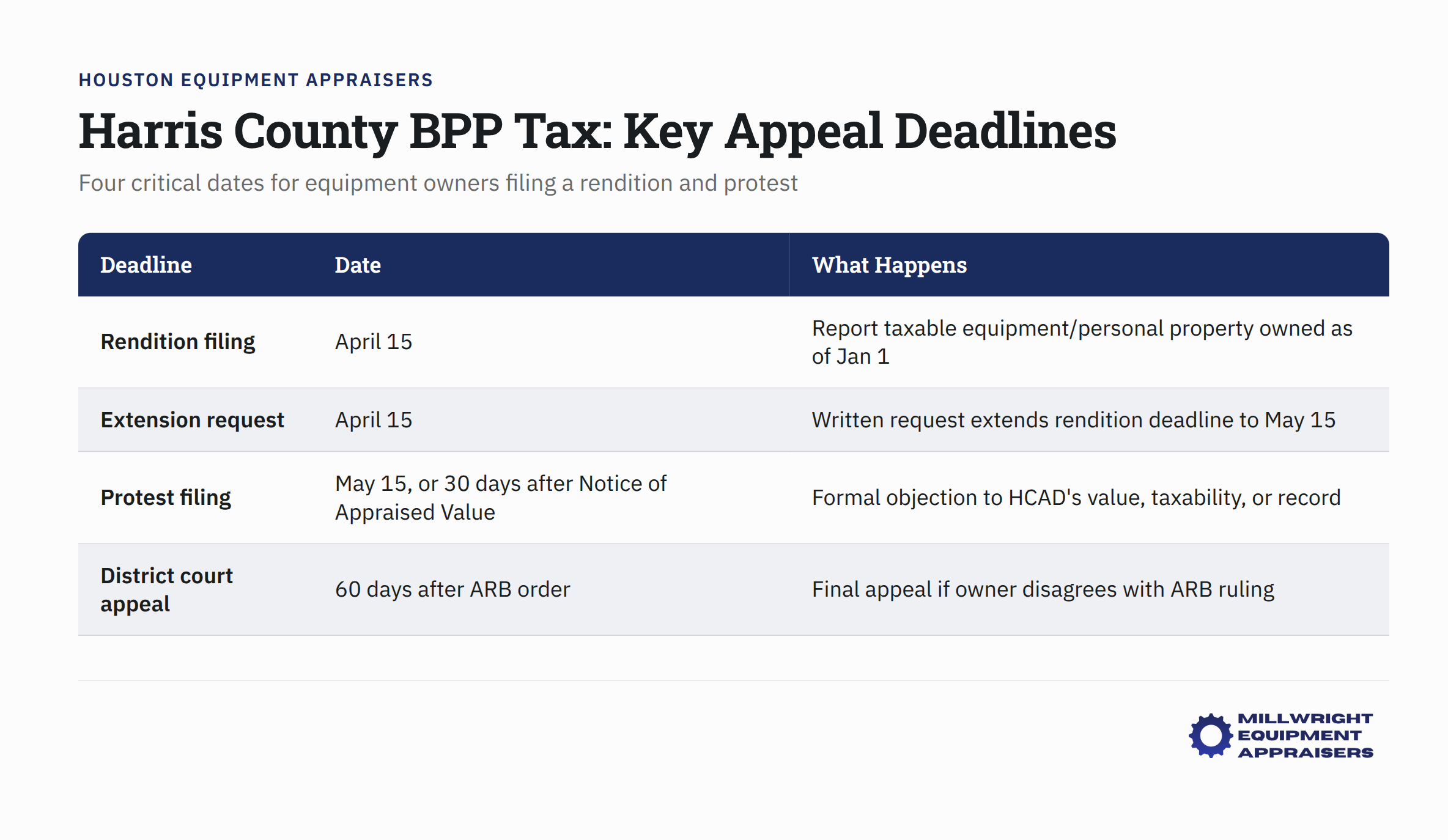
The Harris County BPP rendition is due April 15 each year, moving to the next business day if the 15th falls on a weekend or holiday, as HCAD's business personal property guidance confirms. A business that needs more time can request a written extension by April 15, which pushes the deadline automatically to May 15. The chief appraiser can grant an additional extension of up to 15 days beyond that for good cause shown in writing.
Failing to file, or filing late without an approved extension, triggers a penalty equal to 10% of the taxes ultimately imposed on the property under the Tax Code's rendition penalty provisions. That penalty applies whether or not you ever protest the resulting value, which makes the rendition deadline worth treating as non-negotiable even in a busy quarter.
Quick-Reference: Key Harris County BPP Dates
| Deadline | Date | What Happens |
|---|---|---|
| Rendition filing | April 15 | Report taxable equipment and personal property owned as of January 1 |
| Extension request | April 15 | Written request pushes the rendition deadline to May 15 |
| Protest filing | May 15, or 30 days after the Notice of Appraised Value is mailed, whichever is later | Formal objection to HCAD's assessed value, taxability, or property record |
| ARB hearing | Scheduled after protest is filed | Owner presents evidence; ARB issues a written order |
| District court or arbitration appeal | 60 days after the ARB order (district court) | Final appeal if the owner disagrees with the ARB's ruling |
How to File a Harris County Business Personal Property Tax Appeal
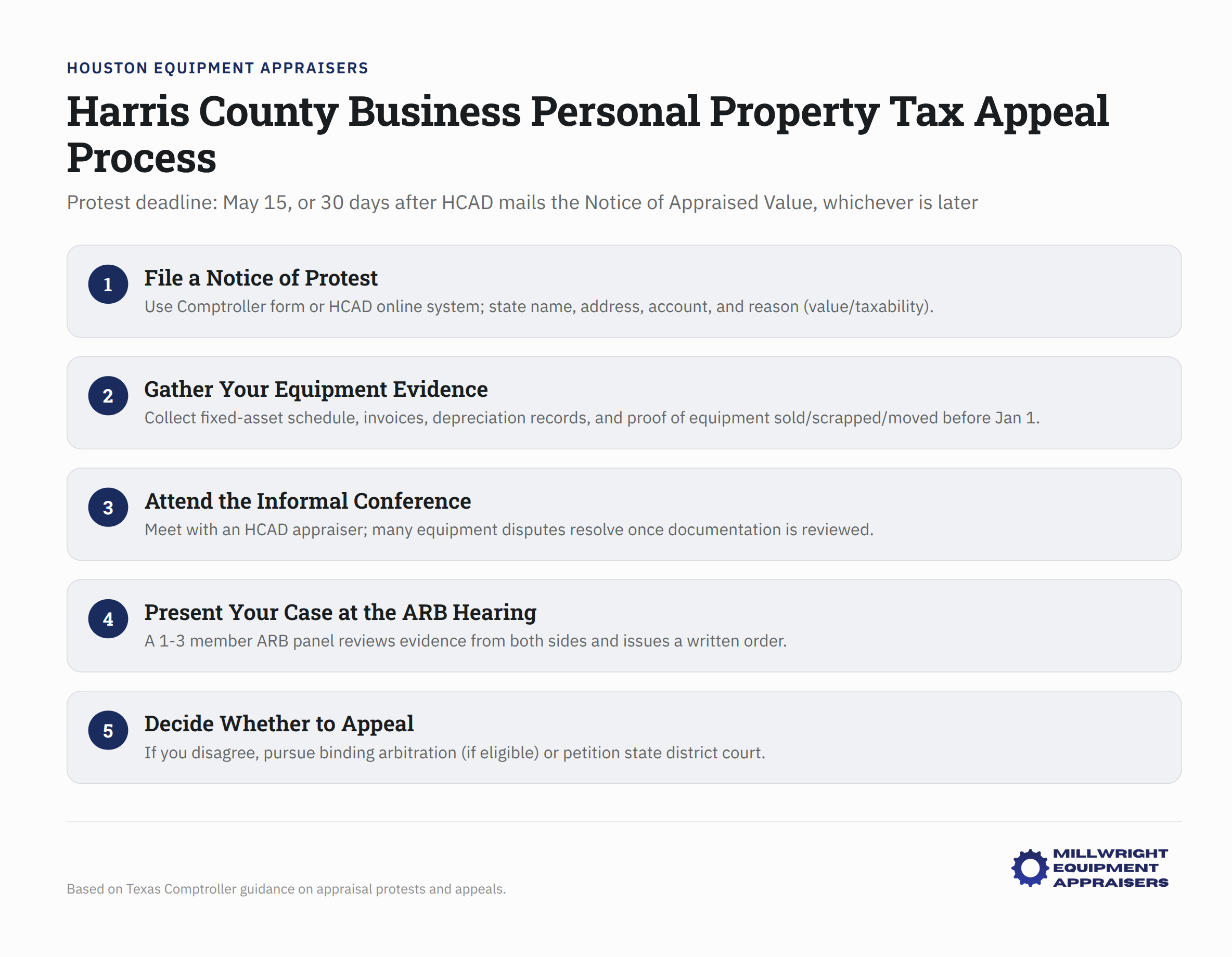
If the Notice of Appraised Value shows a number that's higher than what your equipment is actually worth, the next step is a formal protest to the Appraisal Review Board (ARB). The protest deadline is May 15, or 30 days after HCAD mails the Notice of Appraised Value, whichever is later, according to the Texas Comptroller's guidance on appraisal protests and appeals. That deadline runs from the mailing date, not the date you happen to open the envelope, so don't wait on a notice that arrived late in the mail to start your clock.
Here's how the process typically unfolds for an equipment owner:
- File a Notice of Protest
- Use the Texas Comptroller's property owner's notice of protest form, or HCAD's online filing system. State your name and address, identify the property account, and indicate that you're disputing the appraised value (or taxability, or another protestable action).
- Gather Your Equipment Evidence
- Pull together your fixed-asset schedule, original invoices, depreciation records, and any documentation of equipment that was sold, scrapped, or moved out of Harris County before January 1.
- Attend the Informal Conference (If Offered)
- HCAD often offers an informal settlement conference with an appraiser before the formal hearing. Many disputes over equipment value are resolved at this stage once the appraiser sees documentation the mass appraisal model didn't have.
- Present Your Case at the ARB Hearing
- If the informal conference doesn't resolve the dispute, a one- to three-member ARB panel hears the case and reviews the evidence both sides submit. The panel issues a written order after the hearing.
- Decide Whether to Appeal the ARB's Order
- If you disagree with the ARB's decision, you generally have further options, including binding arbitration for eligible cases or a petition to state district court.
Watch out: A late protest is sometimes allowed by the ARB, but only for good cause, and never after the appraisal records for that year have already been approved. Don't treat the deadline as flexible by default.
What Evidence Actually Moves the Needle
The strongest protests don't just assert that a value is too high; they show it. The ARB expects documentation tied to the specific equipment at issue, not a general objection to the tax bill.
Evidence that typically carries weight in an equipment value dispute includes:
- A detailed fixed-asset list with acquisition dates, original cost, and current condition
- Invoices, leases, or bills of sale for the equipment in question
- Depreciation schedules that reflect actual use, not just a standard percent-good table
- Records of equipment sold, scrapped, or relocated out of the county before January 1
- Evidence of functional or economic obsolescence specific to the equipment or the industry
- An independent valuation of the equipment prepared by a qualified appraiser
That last item is often the difference between a protest that gets a modest adjustment and one that gets the number corrected to reflect actual market value. HCAD's depreciated-cost approach is built for mass appraisal across tens of thousands of accounts; it doesn't account for a specific press that's been run hard for 15 years, a CNC machine that's technologically obsolete despite low mileage, or a fleet of equipment that's harder to sell than the cost tables assume.
An independent equipment appraisal, prepared in accordance with the Uniform Standards of Professional Appraisal Practice (USPAP), gives the ARB a documented, defensible opinion of market value rather than a depreciated cost estimate. Appraisers working in the machinery and equipment vertical typically hold credentials such as the ASA, CAGA, or NEBB, and an appraisal built to those standards carries more weight in a hearing than a spreadsheet alone. If your equipment's assessed value has drifted far from what it would actually sell for, our team can walk you through how fair market value is determined for equipment and what a supportable valuation looks like for an ARB hearing.
After the ARB: Arbitration or District Court
If the ARB's written order doesn't resolve the dispute, Texas law provides two further paths. Binding arbitration is available for eligible cases and generally requires filing the required notice with the chief appraiser within 30 days of receiving the ARB order, along with a deposit. A judicial appeal to state district court is also available, and the Comptroller's guidance notes that a petition for review generally must be filed within 60 days of receiving the ARB's written order.
Both routes are more formal and more costly than the original protest, which is another reason it pays to bring strong evidence to the ARB hearing the first time rather than planning to fix it later on appeal.
Build Your Equipment Records Before the Next Deadline Hits
The rendition and the protest are really one continuous process: what you report in April shapes the value you may need to protest later that spring. Businesses that keep a current, well-documented equipment list rarely face a value fight they can't support with evidence.
If HCAD's assessed value for your machinery or equipment doesn't match what it would actually bring on the market, an independent valuation gives you the documentation an ARB hearing calls for. Request an equipment appraisal from our Houston team and get a USPAP-compliant report built to support your rendition or protest before the next deadline arrives.
This article is provided for general informational purposes only and does not constitute legal, tax, or financial advice. Readers should consult a qualified attorney or CPA regarding their specific circumstances.