
Blog
Fair Market Value vs Orderly Liquidation Value: Which Standard Fits Your Houston Equipment Appraisal
Fair market value and orderly liquidation value are not interchangeable premises for a Houston equipment appraisal: each fits a different purpose, from tax reporting to loan collateral. This guide shows which standard applies to your situation and why using the wrong one can cost you a deduction or delay a loan.
Every equipment appraisal starts with a question most owners never think to ask: under what premise of value? A workover rig, a CNC machine, or a fleet of dump trucks doesn't have one single number attached to it. It has several, depending on why you need the appraisal and what would realistically happen if the equipment changed hands. Get the premise wrong and the report you paid for may be useless for the purpose you needed it for.
This guide walks through the three value standards our appraisers use most often for Houston-area oilfield services, petrochemical, manufacturing, and transportation fleet equipment: fair market value, orderly liquidation value, and forced liquidation value. Understanding which one fits your situation is the first step in determining the fair market value of equipment or scoping any appraisal correctly the first time.
Why the Valuation Standard Matters Before the Appraisal Starts
The standard, sometimes called the "premise of value," determines the assumptions baked into the appraiser's opinion: whether the equipment stays in productive use, whether the seller is under any pressure to sell, and how much time the market has to find a buyer. Change any one of those assumptions and the concluded value changes with it, sometimes substantially, even though the physical asset never moved.
Key takeaway: A single piece of equipment can have a defensible fair market value, a defensible orderly liquidation value, and a defensible forced liquidation value, all at the same time, all correct, because each answers a different question.
What Is Fair Market Value for Equipment?
Fair market value is the price a willing buyer and a willing seller would agree on, with neither party under compulsion to act and both having reasonable knowledge of the relevant facts. This is the standard set out in IRS Publication 561 for tax purposes, including charitable donations, estate valuations, and gift tax filings, and it assumes the asset is exposed to the open market for a reasonable period rather than dumped for a quick sale.
Fair market value is also the right premise for most everyday equipment questions:
- Purchase and sale negotiations between a buyer and seller who both intend to keep operating.
- Insurance coverage and claims, where the equipment is assumed to remain in use rather than be liquidated.
- Divorce and litigation matters, where equipment in a marital or business estate is typically valued in continued use, not under duress.
- Estate, gift, and charitable donation tax reporting, where the IRS specifically requires this standard.
Because fair market value assumes no pressure to sell and a normal marketing period, it's generally the highest of the three standards for a given piece of equipment.
What Is Orderly Liquidation Value?
Orderly liquidation value is the price equipment would bring when the seller is compelled to sell, but has a reasonable, limited window of time, typically months rather than days, to find buyers through a properly managed sale process. The compulsion element is what separates it from fair market value; the reasonable time window is what separates it from a forced or emergency sale.
Orderly liquidation value is typically lower than fair market value, and it's the standard lenders, leasing companies, and asset-based finance providers commonly rely on to size a borrowing base or evaluate collateral. A bank extending a line of credit against a fleet of drilling equipment isn't asking what that equipment would fetch in a leisurely private sale; it's asking what it could recover, over a defined and reasonably short marketing period, if the borrower defaulted. Resources aimed at business financing describe this same logic: lenders want a conservative, liquidation-based estimate of used equipment precisely because their downside scenario is a forced sale, not a negotiated deal.
Orderly liquidation value shows up in a few recurring scenarios:
- Bank and asset-based lending collateral, where the lender needs a borrowing-base figure tied to what could realistically be recovered.
- Bankruptcy or receivership proceedings, where a trustee or court needs to know what assets will generate if wound down over a period of months.
- Planned business wind-downs, where a company is closing a location or a division and liquidating equipment on a defined timeline.
The American Society of Appraisers recognizes orderly liquidation value as a distinct premise within its machinery and technical specialties discipline, separate from both fair market value and the more urgent forced liquidation standard.
Watch out: Orderly liquidation value is not automatically a fixed percentage discount off fair market value. The gap moves with the market for that specific equipment type, and it can widen or narrow depending on how many similar assets are for sale at the same time.
What Is Forced Liquidation Value?
Forced liquidation value applies the same compulsion-to-sell premise as orderly liquidation, but strips out the reasonable time cushion. There's no months-long marketing window; the equipment typically moves through a properly advertised auction or similar sale mechanism on a compressed timeline, often because of a shutdown, foreclosure, or other emergency.
One common misconception is that any auction result equals forced liquidation value. That's not automatically true. An auction with strong advertising, high attendance, and real demand for that equipment category can produce prices close to fair market value. A poorly advertised auction with a thin buyer pool, by contrast, can land well below what the equipment is genuinely worth. The circumstances of the specific sale matter more than the sale mechanism itself.
Matching the Appraisal Standard to Your Purpose
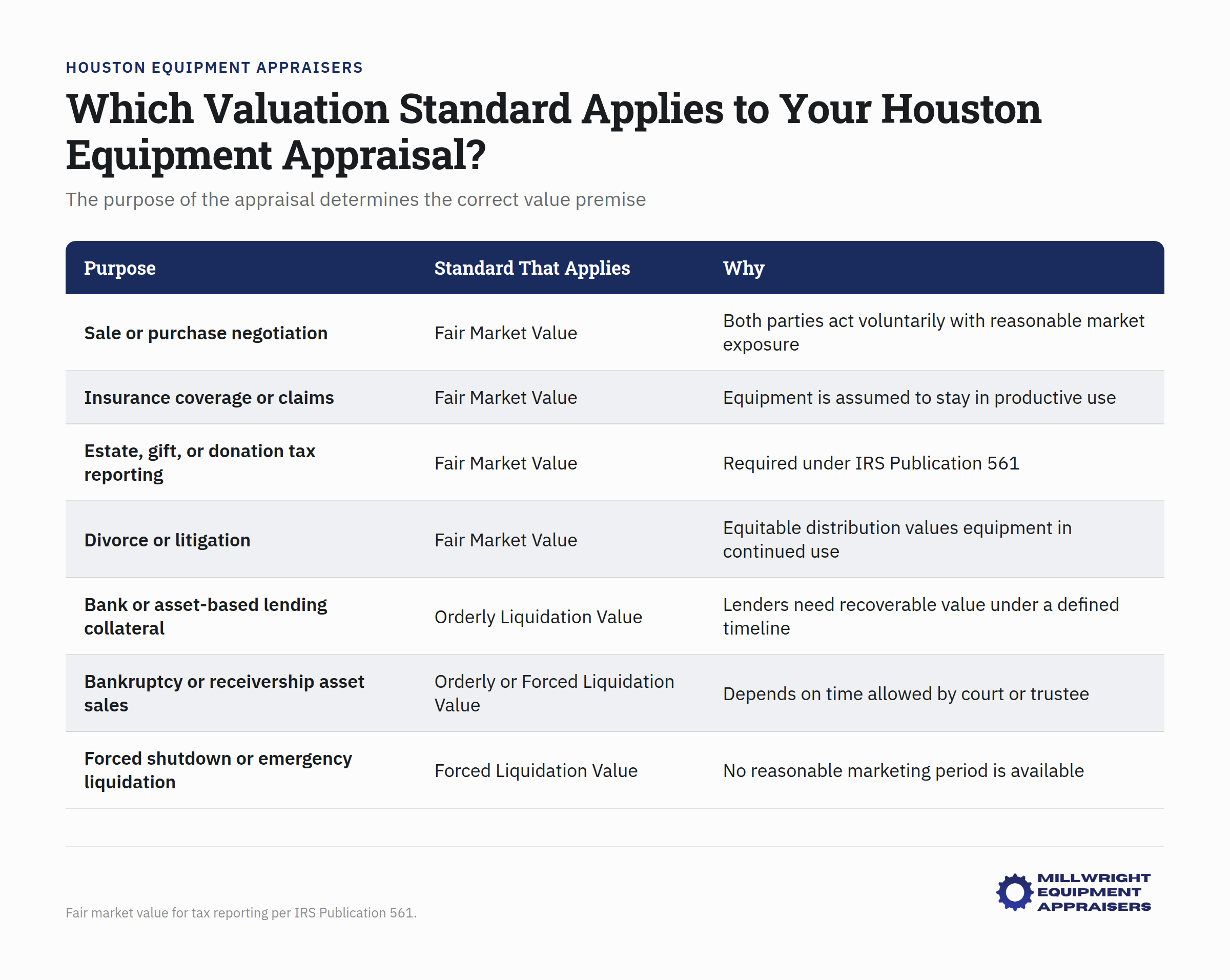
The table below maps common Houston equipment scenarios to the value standard that typically applies. This isn't a matter of preference; the intended use of the appraisal generally dictates the correct premise.
| Purpose | Standard That Applies | Why |
|---|---|---|
| Sale or purchase negotiation | Fair Market Value | Both parties act voluntarily, with reasonable market exposure |
| Insurance coverage or claims | Fair Market Value | Equipment is assumed to stay in productive use |
| Estate, gift, or donation tax reporting | Fair Market Value | Required under IRS Publication 561 |
| Divorce or litigation | Fair Market Value | Equitable distribution generally values equipment in continued use |
| Bank or asset-based lending collateral | Orderly Liquidation Value | Lenders need a recoverable-value estimate under a defined timeline |
| Bankruptcy or receivership asset sales | Orderly or Forced Liquidation Value | Depends on how much time the court or trustee allows |
| Forced shutdown or emergency liquidation | Forced Liquidation Value | No reasonable marketing period is available |
Houston and Gulf Coast Market Examples
The standard you choose matters even more when regional market conditions swing hard, and Houston's equipment-heavy industries are known for exactly that.
Oilfield service equipment, such as workover rigs, pumps, and wellhead assemblies, can see its orderly liquidation value move significantly with energy prices and drilling activity. A rig that would clear a strong orderly liquidation sale during an active exploration cycle may face a much thinner buyer pool during a downturn, even though its fair market value in continued use hasn't changed nearly as much.
Petrochemical and refinery process equipment often carries an installed, in-place value that's meaningfully different from what the same equipment would bring removed and sold separately. A distillation component bolted into a working process line is worth more to a buyer who can keep the line running than it is as a standalone piece of machinery on a resale market.
Manufacturing and machine shop equipment, including CNC machines, tends to hold a more stable relationship between fair market value and liquidation value, since there's a broader, more consistent secondary market for general-purpose machine tools compared to specialized oilfield assets.
Construction fleets tied to regional growth cycles can see liquidation value compress quickly when several contractors are downsizing at once and similar equipment floods the market simultaneously.
None of these examples change the definitions involved. They just illustrate why an appraiser has to look at the actual market for that specific asset type in the Gulf Coast region, not apply a generic discount from one value standard to another.
What Happens When You Use the Wrong Standard
Submitting an appraisal built on the wrong premise doesn't just create an awkward conversation; it usually creates a real problem.
Example: A business owner applies for equipment-backed financing and submits a fair market value appraisal because that's the number that sounds strongest. The lender's underwriting team will typically send it back and require an orderly liquidation value appraisal instead, since that's the figure their collateral policy actually requires. The loan process stalls while a new report is scoped and completed.
Example: A company donating older equipment to a nonprofit has an orderly liquidation value appraisal prepared, again because the number seemed easier to obtain, and uses it to support a charitable deduction. Because the IRS requires fair market value for donation reporting, the deduction is understated at best. At worst, it invites scrutiny for using the wrong standard on a required tax form.
Pro tip: Tell your appraiser the intended use of the report before the engagement starts, not after. "This is for a bank loan" or "this is for a donation deduction" changes the entire assignment, not just the final number.
Our team scopes every engagement around the intended use first, whether that's a lender needing collateral figures for an equipment loan appraisal or a business needing fair market value for tax, insurance, or litigation purposes. Getting the premise right at the start is what makes the report actually usable for its purpose.
Getting the Right Standard From the Start
Fair market value, orderly liquidation value, and forced liquidation value all answer legitimate questions about the same equipment; the trick is matching the standard to the reason you need the appraisal in the first place. Lenders want orderly liquidation value. The IRS wants fair market value. A shutdown or foreclosure calls for forced liquidation value. Mixing these up wastes time and money, and in a tax filing, it can create a bigger problem than a delay.
If you're not sure which standard your situation calls for, request an equipment appraisal with our team and we'll confirm the correct premise before any work begins.
This article is provided for general informational purposes only and does not constitute legal, tax, or financial advice. Readers should consult a qualified attorney or CPA regarding their specific circumstances.