
Blog
How an Independent Equipment Appraisal Strengthens Your Houston Storm or Flood Insurance Claim
After hurricane, tropical storm, or flood damage to Houston commercial equipment, an independent equipment insurance appraisal documents the replacement cost and depreciation figures your proof of loss depends on. This guide walks through RCV versus ACV math, Texas proof-of-loss deadlines, and the coinsurance clause that can quietly cut a payout.
Gulf Coast weather does not spare machinery. Hurricanes, tropical storms, and flash floods routinely damage the oil and gas processing equipment, port material handling fleets, construction machinery, and food processing lines that keep the Houston industrial corridor running. When that equipment is damaged, the insurance payout usually comes down to two numbers: what the equipment would cost to replace today, and how much of that cost the insurer is contractually obligated to pay. An independent equipment appraisal is what turns those two numbers into a documented, defensible figure instead of a guess.
This matters because Houston's industrial base has grown substantially over the past decade, and more of it now sits in flood-prone corridors near the Ship Channel and the bayous that feed it. More exposed equipment means more claims that hinge on getting the valuation right the first time.
Why Storm and Flood Claims for Houston Equipment Need Independent Documentation
Insurers do not dispute coverage questions and valuation questions the same way. Coverage disputes (was the loss caused by flood or wind, was the item excluded) are legal questions. Valuation disputes (what is this equipment worth, how much depreciation applies) are what an appraisal resolves. Texas courts have repeatedly confirmed that the appraisal process exists to determine the amount of loss, not to settle whether the policy covers the loss in the first place, a distinction Texas Supreme Court commentary on compelled appraisal has reinforced even when a coverage dispute is pending.
An independent equipment appraisal for insurance purposes gives you a standards-compliant number to bring to that process instead of relying solely on the insurer's own adjuster. For high-value commercial machinery, that number is frequently the difference between a claim that settles quickly and one that drags through appraisal demand.
Replacement Cost Value vs Actual Cash Value: How Depreciation Changes Your Payout
Most commercial equipment policies pay one of two ways: replacement cost value (RCV), what it costs to buy a new equivalent item today, or actual cash value (ACV), replacement cost minus depreciation for age and wear. The gap between the two can be enormous on equipment that is 5 to 10 years old, which describes most of the processing and material handling fleets working the Gulf Coast.
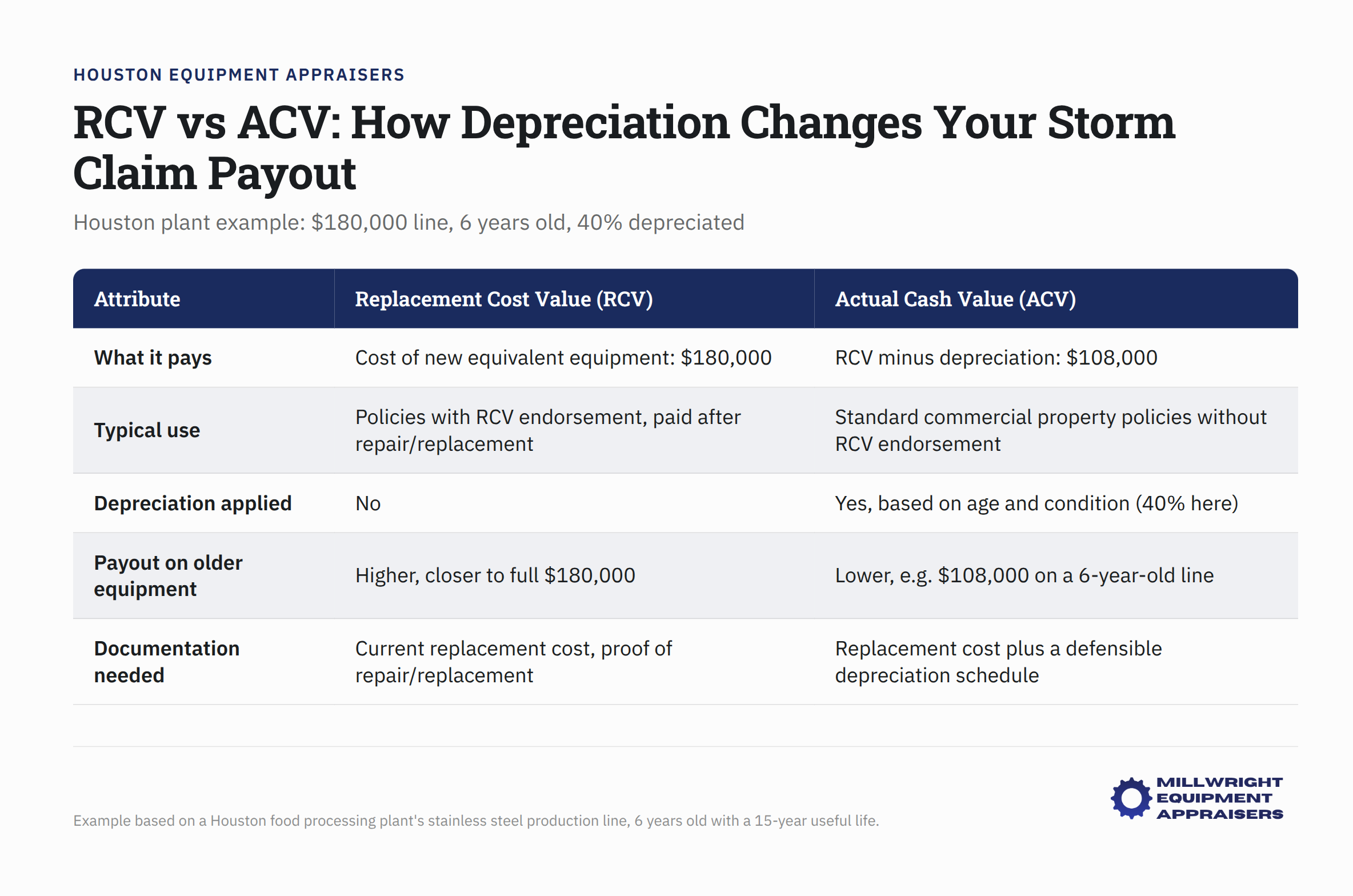
Example: A Houston food processing plant owns a stainless steel production line damaged beyond repair by floodwater. A new equivalent line costs $180,000 to purchase and install today (the RCV). The damaged line was 6 years old with an expected 15-year useful life, so it had used up 40% of its service life. Applying that depreciation:
- Replacement Cost Value (RCV): $180,000
- Depreciation (40% of RCV): $72,000
- Actual Cash Value (ACV): $180,000 minus $72,000 equals $108,000
A policy that pays ACV settles this claim at $108,000. A policy that pays full RCV, or that includes an RCV endorsement paid after repairs are completed and documented, settles closer to the full $180,000. Knowing which basis applies before you file, and having an appraiser's documented replacement cost and depreciation schedule to support either figure, keeps the insurer's adjuster from setting both numbers unilaterally.
| Replacement Cost Value (RCV) | Actual Cash Value (ACV) | |
|---|---|---|
| What it pays | Cost of new equivalent equipment | RCV minus depreciation |
| Typical use | Policies with RCV endorsement, paid after repair/replacement | Standard commercial property policies without RCV endorsement |
| Depreciation applied | No | Yes, based on age and condition |
| Payout on older equipment | Higher | Lower |
| Documentation needed | Current replacement cost, proof of repair/replacement | Replacement cost plus a defensible depreciation schedule |
What Your Proof of Loss Must Include After Equipment Damage
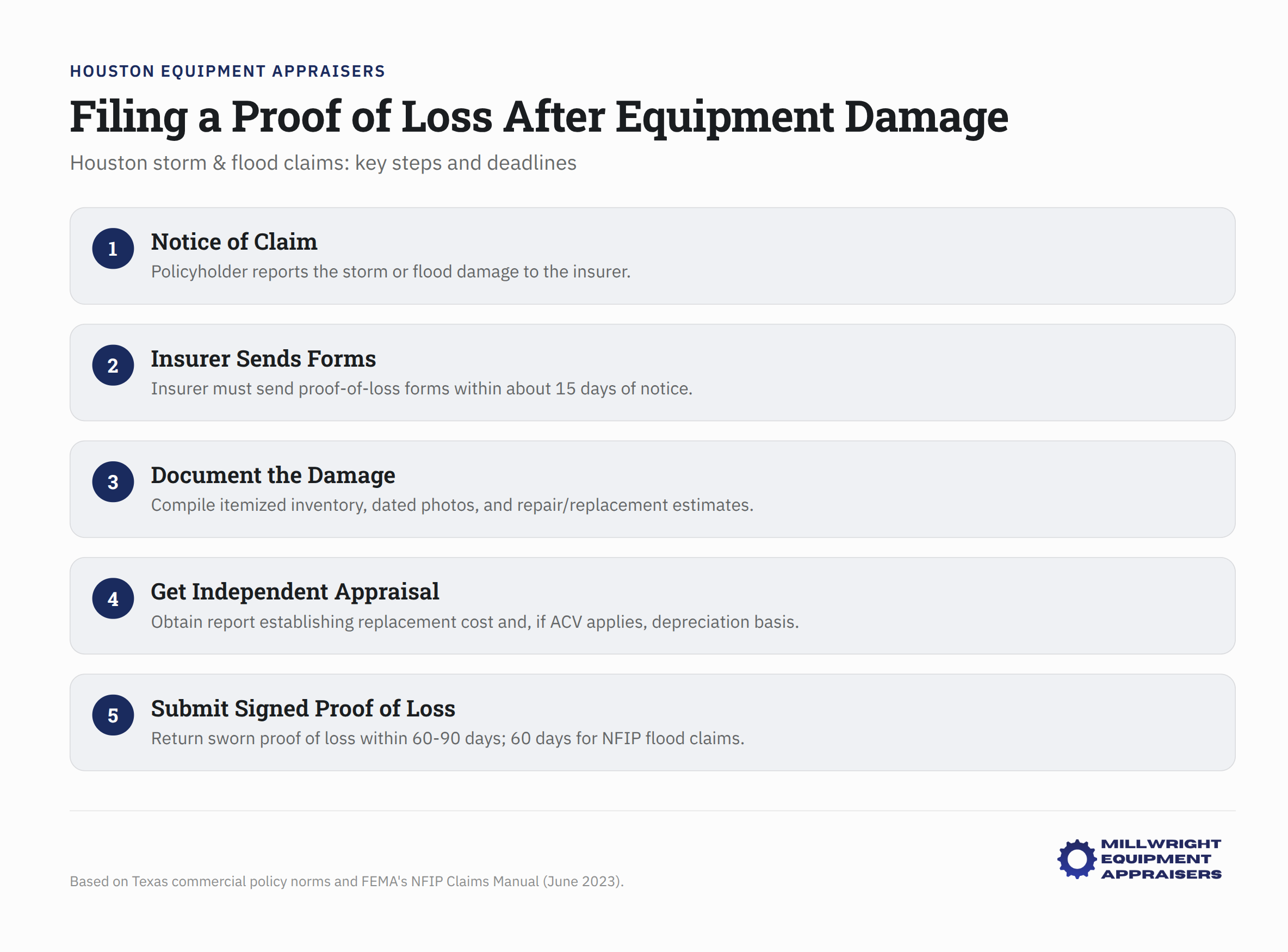
A proof of loss is the sworn, itemized statement of loss you submit to the insurer, and it is the document that actually triggers payment. Texas insurers are required to send you the proof-of-loss forms within about 15 days of receiving notice of a claim, and most commercial policies then require the signed, sworn proof of loss back within 60 to 90 days, depending on the specific policy language.
For flood losses handled under the National Flood Insurance Program, the deadline is explicit: FEMA's NFIP claims guidance requires the policyholder to submit a signed, sworn proof of loss within 60 days of the loss unless FEMA grants an extension, and the same guidance sets a 20-day window for each side to name a competent, impartial appraiser once either party demands appraisal over a disputed actual cash value.
A complete proof of loss for damaged commercial equipment typically needs:
- An itemized inventory of every damaged asset, with manufacturer, model, and serial number where available
- Dated photographs documenting the damage and, for flood claims, the equipment's location relative to ground level
- Repair or replacement estimates from qualified vendors
- An independent appraisal report establishing both replacement cost and, where ACV applies, a documented depreciation basis
Our checklist of documents needed for a USPAP-compliant equipment appraisal walks through what to gather before an appraiser's site visit, which shortens the time between the loss and a submittable proof of loss.
Separately, if your claim stalls, Texas's Prompt Payment of Claims Act sets deadlines for the insurer's side of the process: acknowledging and beginning investigation within 15 business days of notice, and accepting or rejecting the claim within 15 business days of receiving all requested items, with payment due within 5 business days after acceptance, according to the statutory summary published by Thompson Coe. Missing those deadlines can expose the insurer to 18% annual interest on the claim amount plus attorney's fees under Texas Insurance Code Section 542.060.
New Texas Appraisal Deadlines Effective January 1, 2026
Texas Insurance Code Chapter 1813 now requires covered residential property and personal auto policies issued or renewed on or after January 1, 2026 to include a binding appraisal provision, according to the statute itself. An appraisal award under that provision is binding on both sides except in cases of fraud, accident, material mistake, or an award made without authority.
The same legislation set specific clocks on the appraisal process: a policyholder or insurer has up to 1 year to demand appraisal, 20 days to select an appraiser once demand is made, 120 days for the two appraisers to agree, and 240 days maximum to reach a final award, with additional time allowed for weather-related catastrophes or major disasters, per the legislative deadline summary. Commercial policies are not automatically covered by Chapter 1813 the way personal auto and residential property are, but many carriers extend similar appraisal-clause language into commercial equipment coverage, so it is worth checking your policy's appraisal provision directly rather than assuming a deadline.
The Coinsurance Clause Risk on Commercial Equipment Policies
Many commercial equipment and property policies include a coinsurance clause requiring the owner to insure the equipment for a set percentage, commonly 80% or 90%, of its full replacement value. If the equipment is underinsured relative to that threshold, the insurer pays only a proportional share of the loss, even on a partial loss.
Example: A construction company insures a fleet of heavy equipment for $500,000, but an appraisal shows the true replacement cost is $700,000. The policy carries an 80% coinsurance requirement, meaning the required insurance amount is $560,000 (80% of $700,000). The company is carrying $500,000 of the required $560,000, or 89.3%. On a $100,000 storm-damage claim, the insurer applies that same 89.3% ratio and pays roughly $89,300 instead of the full $100,000.
Watch out: Coinsurance penalties apply even when the underinsurance was accidental. An independent appraisal that establishes current replacement cost before a loss, not just after one, is the only way to know whether your coverage limit actually satisfies the coinsurance requirement.
Which Houston-Area Equipment Faces the Highest Storm and Flood Exposure
Houston's industrial base sits at the center of this risk. Oil and gas processing equipment along the Ship Channel, port and logistics material handling fleets serving the region's growing warehouse and distribution footprint, construction and heavy equipment staged at job sites throughout the metro, and manufacturing and food processing lines all share exposure to both storm-surge flooding and wind-driven hail damage during hurricane season.
Much of this equipment is also difficult to value from a distance: processing lines and material handling systems are frequently customized, retrofitted, or partially depreciated in ways a generic online estimate cannot capture. That is exactly the gap an on-site or documented remote appraisal is built to close, whether the underlying loss involves a food processing line, a fleet of forklifts on a flooded dock, or specialized medical equipment at a Houston medical facility.
Get Your Equipment Documented Before You File
An insurer's adjuster works for the insurer. An independent appraisal gives you your own documented replacement cost, depreciation schedule, and condition assessment before the proof-of-loss clock runs out. Whether your claim involves NFIP flood coverage, a Texas Windstorm Insurance Association policy, or a standard commercial property policy, having that number in hand before you sign a sworn proof of loss puts you in a stronger negotiating position.
Our appraisers prepare USPAP-compliant equipment appraisals for storm and flood insurance claims across the Houston area. If your equipment was damaged, request an equipment appraisal before your proof-of-loss deadline arrives.
This article is provided for general informational purposes only and does not constitute legal, tax, or financial advice. Readers should consult a qualified attorney or insurance professional regarding their specific claim and policy language.