
Blog
Donate Heavy Equipment in Houston for a Tax Deduction: IRS Form 8283 Rules Explained
Donating heavy equipment to a Houston nonprofit or trade school can unlock a real tax deduction, but the IRS ties the paperwork to exact dollar thresholds. This guide walks through the $500, $5,000, and $500,000 rules under Form 8283, with worked examples for a single dozer, a mid-size donation, and a large fleet gift.
Donating a dozer, a skid steer, or a fleet of retired construction equipment to a Houston nonprofit or trade school can be a smart move at tax time, but the deduction only holds up if the paperwork matches the dollar amount you're claiming. The IRS ties three specific thresholds, $500, $5,000, and $500,000, to three different sets of requirements, and missing the right one is the fastest way to lose a deduction you otherwise earned. This guide breaks down what triggers a qualified equipment appraisal, what belongs on Form 8283, and how the rules play out across three realistic Houston donation scenarios.
What Counts as a Qualified Heavy Equipment Donation in Houston?
A heavy equipment donation qualifies for a charitable deduction when the recipient is a qualified organization under IRC Section 170(c), and the donor properly substantiates the claimed value. Heavy equipment (dozers, excavators, cranes, skid steers, forklifts, and similar machinery) is tangible personal property, so it falls under the general noncash contribution rules rather than the special vehicle-donation provisions that apply to cars, boats, and airplanes.
Before assuming any local nonprofit or school qualifies, confirm the recipient's federal tax-exempt status directly. A Texas nonprofit registration alone does not establish 501(c)(3) status for deduction purposes. Two examples of the kind of Houston-area organization that regularly benefits from donated heavy equipment are Houston Community College's Heavy Vehicle, Diesel & Industrial Technology program, which uses donated machinery for hands-on student training, and WorkTexas, a Houston-area workforce and trade-training nonprofit that equips shop and welding classrooms with donated equipment. These are illustrative examples of the type of donee that can receive heavy equipment, not a guarantee that either organization will accept a specific donation or that the IRS will allow the resulting deduction. Confirm a program's current intake policy and tax-exempt status before you commit the equipment, and remember that acceptance of the gift by the school or nonprofit is a separate question from whether the IRS allows your deduction.
The Three IRS Dollar Thresholds That Control Your Deduction
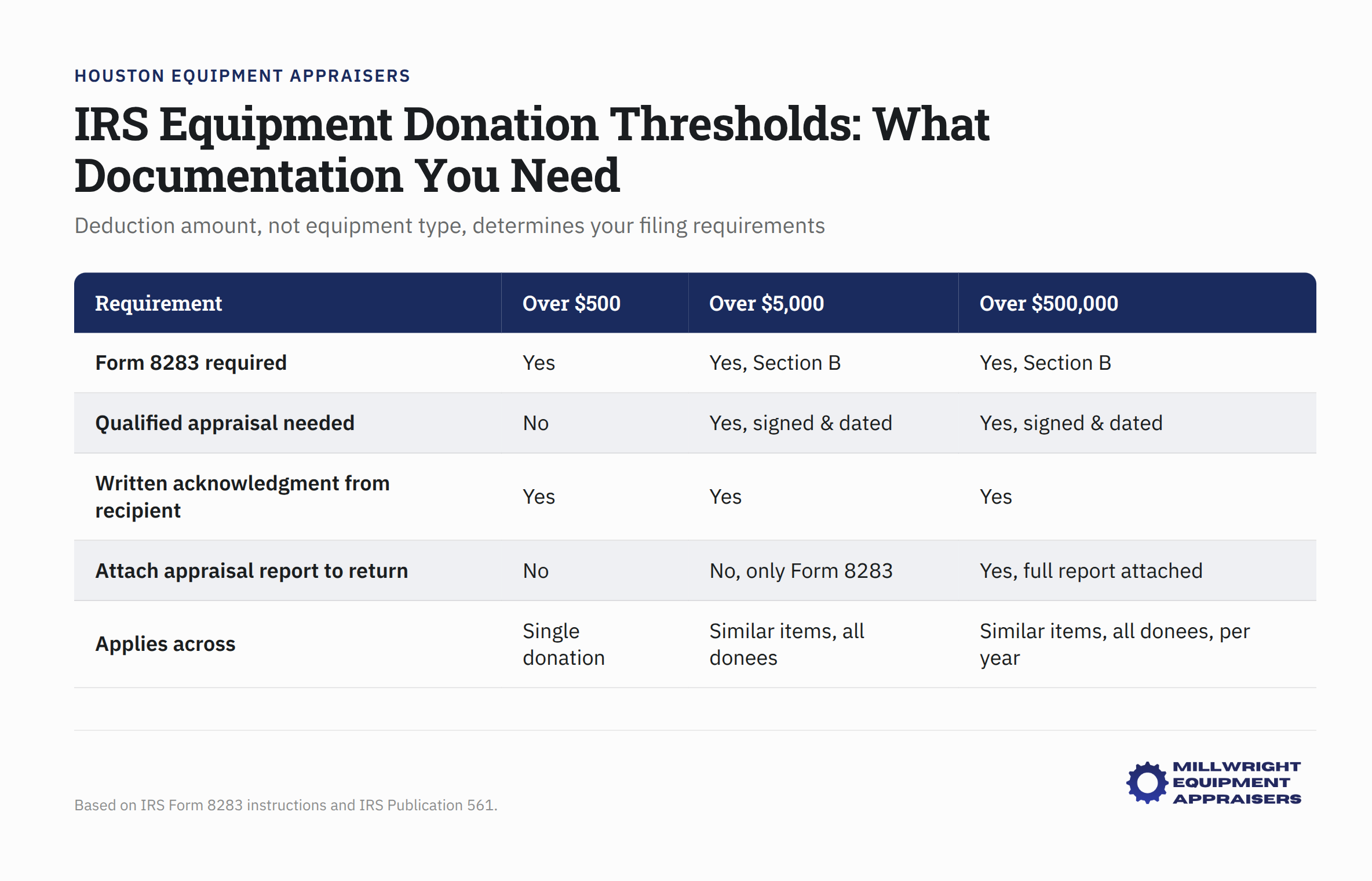
The amount you claim, not the type of equipment, determines what the IRS requires from you. Three thresholds matter for any noncash equipment donation:
- Over $500: You must file IRS Form 8283 with your federal return. No appraisal is required yet, but you still need a contemporaneous written acknowledgment from the recipient and solid records of cost, acquisition date, and how you determined value.
- Over $5,000 for one item, or a group of similar items: You must obtain a qualified appraisal signed and dated by a qualified appraiser, complete Section B of Form 8283, and attach the completed Form 8283 (not the appraisal itself) to your return. This is the threshold most equipment donors hit, and IRS Publication 561 is the government's primary guidance on how that value should be determined and documented.
- Over $500,000, aggregated across similar items donated to all organizations that year: You must attach the full qualified appraisal report to your tax return, in addition to meeting the Section B and Form 8283 requirements above.
The $5,000 and $500,000 thresholds are not per-donee limits. If you donate similar equipment to more than one nonprofit or school in the same tax year, the IRS aggregates the claimed value of those similar items when deciding which threshold applies. Splitting a fleet donation across two recipients does not avoid the appraisal requirement.
Worked Examples: Three Houston Donations, Three Sets of Rules
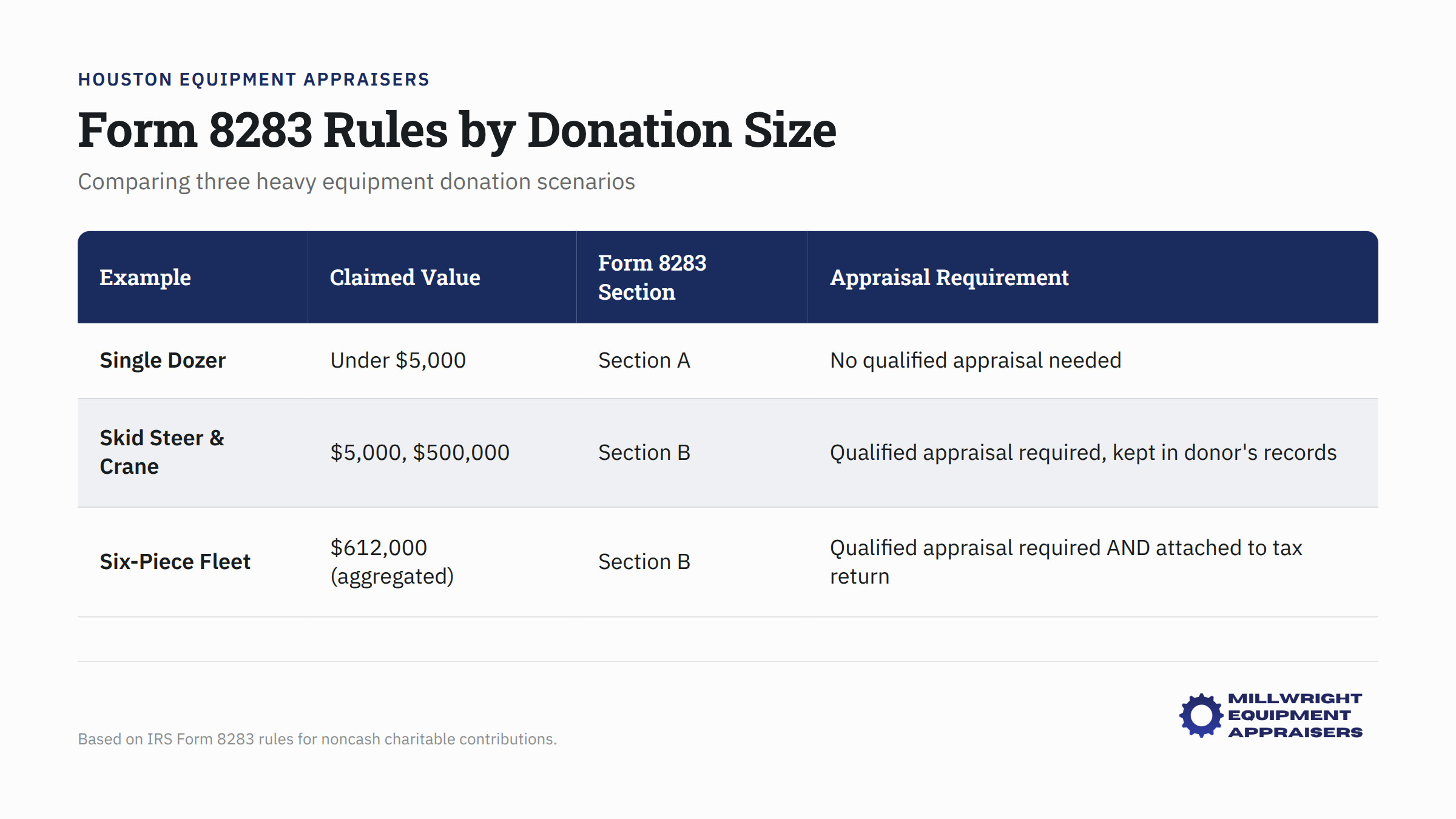
The cleanest way to see how these thresholds actually work is to walk through three realistic donations, each landing in a different bracket.
The Single Dozer: Claimed Value Under $5,000
A Houston contractor donates a used dozer to a local trade school and claims a fair market value of $4,200 based on comparable sales of similar-age, similar-hours equipment. Because the claimed value is above $500 but at or below $5,000, this falls under Form 8283, Section A. No qualified appraisal is required. The donor still needs a contemporaneous written acknowledgment from the school describing the equipment and confirming no goods or services were exchanged, along with records supporting the $4,200 figure.
The Mid-Size Donation: Section B and a Qualified Appraisal
A construction company donates a used skid steer and a small mobile crane to WorkTexas in the same tax year, with a combined claimed value of $38,500. Because this exceeds $5,000 for a group of similar items, the donor must obtain a qualified appraisal, signed and dated by a qualified appraiser, before filing. The donor completes Form 8283, Section B, has the appraiser sign the declaration, and has WorkTexas complete the donee acknowledgment. Only the completed Form 8283 goes to the IRS with the return; the appraisal itself is kept on file, not attached.
The Large Fleet Donation: Aggregated Value Over $500,000
A regional equipment company retires six pieces of heavy machinery over the course of a year, donating three to Houston Community College's diesel technology program and three to a second qualifying nonprofit. The combined claimed value across all six comes to $612,000. Because the aggregated value of these similar items exceeds $500,000, the donor needs a qualified appraisal for Section B, and must also attach the complete qualified appraisal report to the tax return itself, on top of the Form 8283 filing. This is the only bracket where the appraisal document leaves the donor's file and goes directly to the IRS.
What a Qualified Appraisal Must Actually Include
A qualified appraisal for heavy equipment is not a one-page value opinion. It needs to identify the equipment's make, model, serial number, and other identifying features, state the valuation date, describe physical condition, and explain the valuation method and the specific market data relied on, along with any liens, defects, or unusual circumstances affecting value.
The methodology matters as much as the number. A defensible equipment valuation looks at comparable sales of similar machines, age and recorded hours, maintenance history, included attachments, and the geographic market where the equipment would actually sell, rather than leaning on a dealer's list price or an unsupported estimate. Our appraisers determine fair market value for donated equipment the same way we would for any equipment valuation engagement: through documented market evidence, prepared in accordance with USPAP.
Watch out: A donee organization's signature on Form 8283 only acknowledges receipt of the equipment. It does not establish fair market value and does not guarantee the IRS will accept your claimed deduction. That determination belongs to the IRS, not the school, the nonprofit, or the appraiser.
Timing Rules You Cannot Miss
A qualified appraisal has a narrow valid window. It must be dated no earlier than 60 days before the date of the contribution, and it must be received no later than the due date, including extensions, of the return on which the deduction is first claimed. If the deduction is first claimed on an amended return, the appraisal must be in hand before that amended return is filed.
Getting the appraisal too early or too late does not just create a paperwork problem: it can invalidate the appraisal for deduction purposes entirely. Building the appraisal into your donation timeline from the start, rather than treating it as an afterthought once the equipment is already gone, avoids the scramble.
Pro tip: Line up your appraiser before the equipment leaves your yard. An appraisal completed after the fact, based on photographs and secondhand descriptions, is harder to defend than one based on a direct inspection of the equipment in its as-donated condition.
Documenting the Donation Correctly
Beyond the appraisal itself, a complete donation file should include the following:
- A contemporaneous written acknowledgment from the recipient organization, required for any single contribution of $250 or more, describing the equipment and stating whether any goods or services were provided in exchange.
- Records of your original cost or basis in the equipment, along with the date and manner of acquisition.
- The completed Form 8283, with Section A or Section B filled out depending on the claimed value.
- Confirmation of the recipient's federal tax-exempt status at the time of the gift.
- For related-use questions (equipment donated to a trade school for instructional use is on stronger footing than equipment donated for resale), documentation of how the recipient intends to use the equipment.
Holding onto this file matters even in years when no appraisal is required. The IRS can request more information at any time, and thin documentation is the most common reason an otherwise legitimate deduction gets challenged.
Donating heavy equipment to a Houston trade program or workforce nonprofit can be good for the recipient and good for your tax return, but the deduction only survives scrutiny if it's built on the right threshold, the right form, and, once you cross $5,000, a properly timed qualified appraisal. If you're planning a donation and need a USPAP-compliant valuation before you file, request an equipment appraisal and we'll scope the assignment around your donation timeline.
This article is provided for general informational purposes only and does not constitute legal, tax, or financial advice. Readers should consult a qualified attorney or CPA regarding their specific circumstances.