
Blog
Documents Needed for a USPAP-Compliant Equipment Appraisal: a Houston Checklist
Knowing the documents needed for equipment appraisal work before the appraiser arrives speeds up the assignment and produces a stronger, more defensible report. This checklist walks Houston construction, energy, marine, and manufacturing owners through exactly what to gather and why USPAP requires it.
Houston owners in construction, oil and gas, manufacturing, and marine industries often assume an equipment appraisal starts and ends with a site visit. In practice, the quality of the report depends heavily on what the owner hands over before the appraiser ever walks the yard. Pulling together the right paperwork in advance is the single biggest thing you can do to speed up the assignment and strengthen the final opinion of value.
This checklist covers what our equipment appraisal service asks Houston clients to gather before an inspection, and why each item matters under the standards that govern the appraisal profession.
Why Documentation Drives a Defensible Appraisal
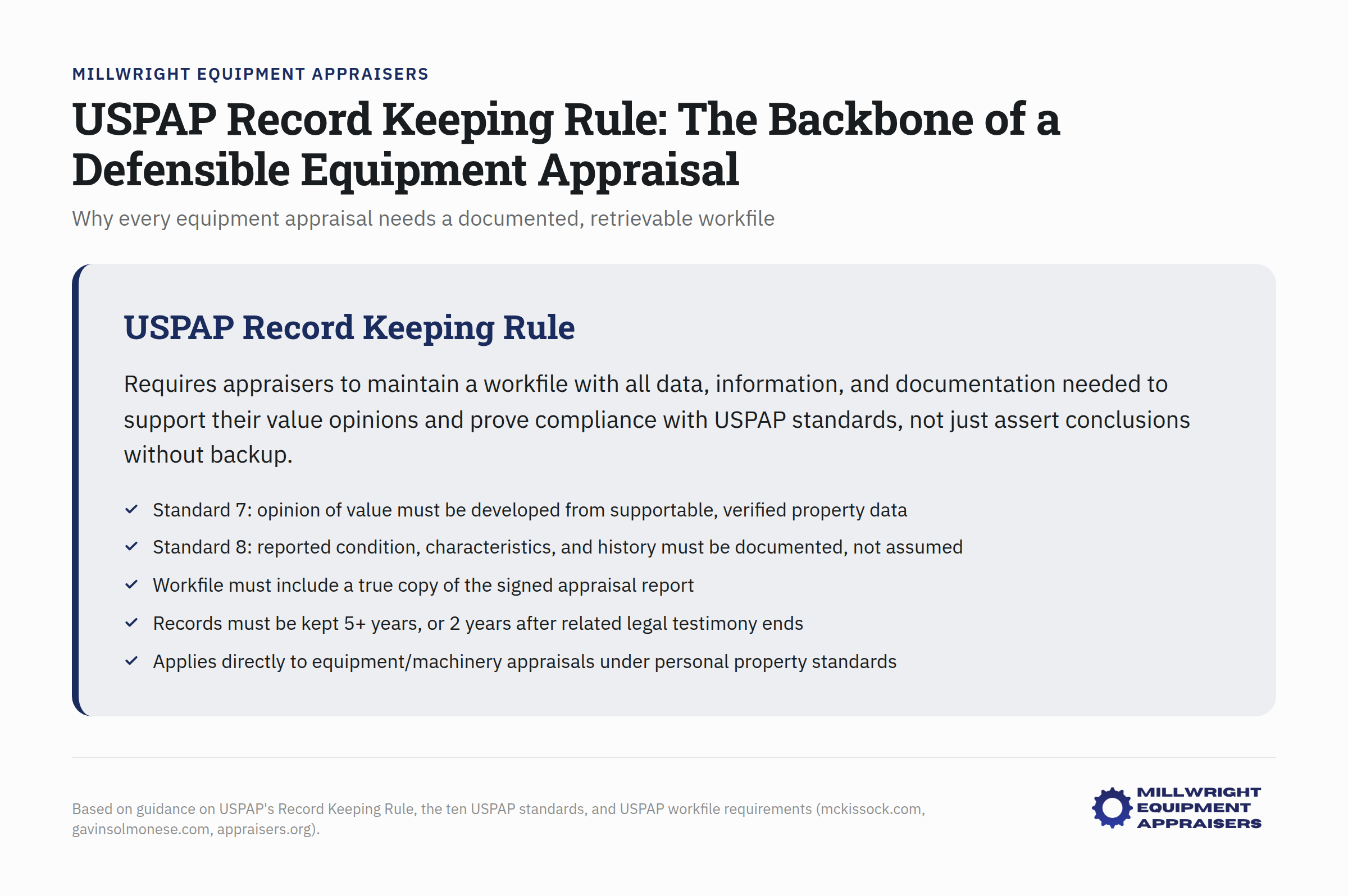
A USPAP-compliant equipment appraisal is only as strong as the workfile behind it. USPAP's Record Keeping Rule requires the appraiser to maintain a workfile containing all data, information, and documentation necessary to support the opinions and conclusions in the report, and to demonstrate compliance with the standards themselves, as explained in guidance on the USPAP Record Keeping Rule. That workfile has to hold up for years after the report is delivered. A true copy of the signed report, along with the data behind it, generally needs to stay on file for at least five years, or two years after any related legal testimony concludes, whichever is longer.
Equipment and machinery appraisals fall under USPAP's personal property standards. Standard 7 governs how the appraiser develops the opinion of value, and Standard 8 governs how that opinion gets reported, with both standards requiring that the property and its relevant characteristics, condition, and value-relevant history be properly identified and supportable, not assumed, as outlined in an overview of the ten USPAP standards. The appraiser's workfile must include a true copy of the signed report itself, since USPAP requires that certification to be documented and retained, per guidance on USPAP and the appraiser's workfile.
In plain terms: the appraiser cannot simply assert that a piece of equipment is in good condition or was purchased for a given price. There has to be something in the file backing it up. That is where the owner's paperwork comes in.
Key takeaway: Every document on this checklist exists to give the appraiser something concrete to cite, so the final report can withstand review by a lender, insurer, court, or auditor.
Identification: Serial Numbers, Manufacturer, and Model Data
The first thing an appraiser needs is a precise identity for every asset in the assignment, not a general description. Pull together the following for each piece of equipment before the inspection:
- Manufacturer, model, and serial number, taken directly from the data plate or nameplate rather than from memory or an old spreadsheet
- Year of manufacture and, where applicable, model year versus year placed in service
- Configuration details such as attachments, options, engine specs, or capacity ratings that affect what the equipment can actually be compared against in the market
This level of detail matters more than owners often expect. Two forklifts with the same model number can carry very different values if one has a specialty attachment or a different lift capacity. Vague descriptions force the appraiser to guess, and guesses do not survive scrutiny.
Purchase Invoices, Capital Improvements, and Cost Records
Cost data anchors the cost approach and helps the appraiser sanity-check market evidence against what the asset actually cost to acquire and improve. Gather:
- Original purchase invoices or bills of sale, showing the installed cost including freight, taxes, and setup
- Acquisition dates, ideally pulled from accounting or fixed-asset records rather than recalled from memory
- Records of major capital improvements, such as rebuilds, retrofits, or engine overhauls, with invoices or work orders showing what was done and when
- Depreciation schedules from your fixed-asset system, which help the appraiser reconcile book value against the appraised value
Houston owners who also deal with Harris County business personal property tax filings often already have much of this on hand, since the Harris Central Appraisal District applies its own cost-based schedules to machinery and equipment for assessment purposes, as described in Harris County's Business & Industrial Property valuation guide. Those tax records are not a substitute for a USPAP-compliant appraisal, but pulling them out for the appraiser saves time and gives a useful cross-check.
Maintenance, Repair, and Usage Records
Condition drives value more than almost anything else for machinery and equipment, and condition claims need support. Have these ready:
- Maintenance and repair logs, showing routine service history and any major component replacements
- Usage data, including hour meter readings, mileage, or production cycle counts, depending on the asset type
- Downtime or breakdown records, if the equipment has had significant unplanned outages that affect its remaining useful life
This matters across every Houston vertical we work with. Offshore and onshore energy operators track hours and service intervals closely because uptime is tied directly to revenue. Marine operators log engine hours and haul-out inspections. Manufacturing plants track preventive maintenance cycles on production lines. Construction fleets track hours and repair history for resale planning. Whatever the industry, the appraiser wants to see documentation of actual condition, not a verbal assurance that the equipment "runs great."
Ownership, Title, and Prior Appraisal Documents
Before the appraiser can value the correct interest in a piece of equipment, they need to confirm exactly what interest exists. Bring:
- Titles, for any mobile or titled equipment such as trucks, trailers, or marine vessels
- Lease agreements, finance contracts, or security agreements, if the equipment is leased, financed, or pledged as collateral
- Any liens or encumbrances that a lender, buyer, or court might need disclosed
- Prior appraisal reports, if one exists, even if it is several years old. A previous report gives the appraiser a useful reference point for what has changed since then.
This category matters for equipment being used as loan collateral or equipment involved in a business dispute, since the appraiser has to clearly state whose interest is being valued and whether that interest is unencumbered.
Photographs: What the Appraiser Actually Needs to See
Photographs are part of the evidentiary record, not decoration for the report. At minimum, plan to capture, or have ready for the appraiser to capture during inspection:
- Overall shot of the asset, showing the full equipment from a distance that establishes general condition and configuration
- Nameplate or data plate close-up, legible enough to confirm serial number, model, and manufacturer information without guesswork
- Condition detail shots, focused on any wear, damage, corrosion, or repairs that materially affect value
Good photographs do double duty. They support the condition statements in the report, and they sit in the appraiser's workfile as the documentation required to back up those statements years later if the report is ever questioned.
How Houston's Industries Shape the Checklist
The core document list stays the same across industries, but the emphasis shifts. Energy and oilfield equipment appraisals lean heavily on usage hours, service intervals, and environmental exposure records, since heavy equipment used in oil and gas settings faces accelerated wear that needs to be documented rather than assumed, a point covered in industry guidance on USPAP compliance for heavy equipment in oil and gas appraisals. Marine equipment appraisals put more weight on hull and engine survey records and title documentation. Manufacturing appraisals lean on maintenance logs and capital improvement records tied to production lines. Construction fleets tend to have the most straightforward paper trail, since hours and repair history are usually tracked for resale planning already.
Whatever the vertical, owners who want a clear answer on how the fair market value of their equipment gets determined benefit from understanding that the appraiser's conclusion is only as strong as the records behind it. The same is true for owners working through the process of valuing heavy equipment for a sale, dispute, or financing decision.
Watch out: Do not wait until the day of inspection to start pulling records together. Missing cost data or maintenance logs can force the appraiser to note limiting conditions in the final report, which weakens its credibility with lenders, insurers, and courts.
Get Your Paperwork Ready Before You Call
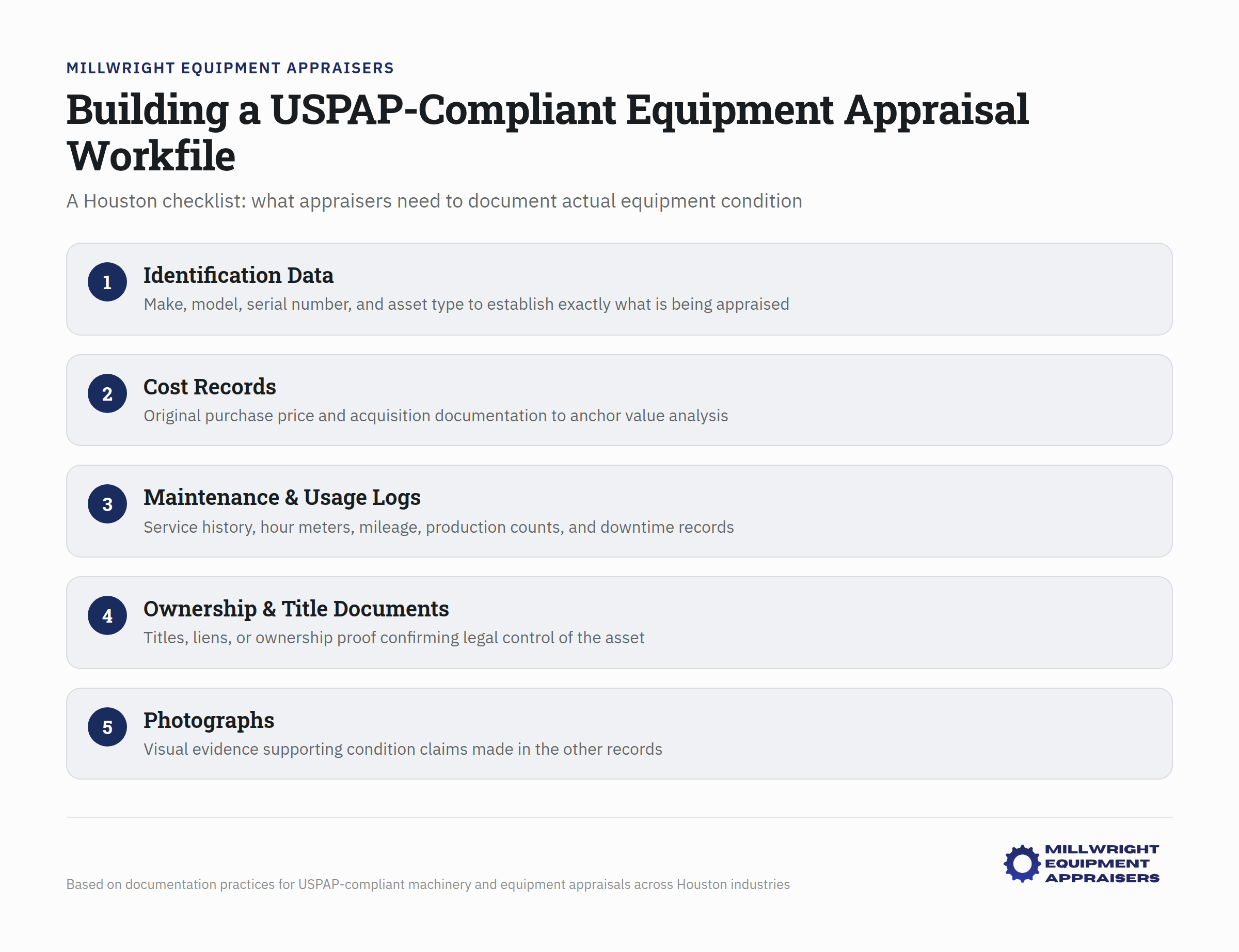
A USPAP-compliant equipment appraisal is built on documentation, not just an on-site walk-through. Serial numbers and data plate details establish identity. Purchase invoices and depreciation schedules establish cost. Maintenance and usage logs establish condition. Title and ownership documents establish the exact interest being valued. Photographs tie it all together and give the appraiser something concrete to cite months or years down the road.
Pulling this together in advance does not just save time on the day of inspection. It gives the appraiser more to work with, which typically means a more thorough, better-supported opinion of value, whether the report is headed to a lender, an insurer, a court, or a business partner.
This article is provided for general informational purposes only and does not constitute legal, tax, or financial advice. Readers should consult a qualified attorney or CPA regarding their specific circumstances.